<?xml version="1.0" encoding="utf-8"?><feed xmlns="http://www.w3.org/2005/Atom" ><generator uri="https://jekyllrb.com/" version="4.4.1">Jekyll</generator><link href="https://buddhistuniversity.net/feed/content/bart.xml" rel="self" type="application/atom+xml" /><link href="https://buddhistuniversity.net/" rel="alternate" type="text/html" /><updated>2026-04-20T19:14:30+07:00</updated><id>https://buddhistuniversity.net/feed/content/bart.xml</id><title type="html">The Open Buddhist University | Content | Buddhist Art</title><subtitle>A website dedicated to providing free, online courses and bibliographies in Buddhist Studies. </subtitle><author><name>Khemarato Bhikkhu</name><uri>https://twitter.com/buddhistuni</uri></author><entry><title type="html">Living Monumentality: The Socio-Political Landscapes of Big Buddha Statues (dàfó 大佛) in Southern Sichuan, China (700–1200 ce)</title><link href="https://buddhistuniversity.net/content/articles/living-monumentality_monteith-francesca-et-al" rel="alternate" type="text/html" title="Living Monumentality: The Socio-Political Landscapes of Big Buddha Statues (dàfó 大佛) in Southern Sichuan, China (700–1200 ce)" /><published>2026-04-14T07:46:41+07:00</published><updated>2026-04-14T07:46:41+07:00</updated><id>https://buddhistuniversity.net/content/articles/living-monumentality_monteith-francesca-et-al</id><content type="html" xml:base="https://buddhistuniversity.net/content/articles/living-monumentality_monteith-francesca-et-al"><![CDATA[<blockquote>
  <p>This paper examines the extent to which the construction of these Big Buddhas represents the appropriation of Buddhist RCR (Rock-Cut Religious) sites by non-local political and religious elites as a form of social control, and it is herein proposed that these social and religious elites commissioned and maintained such projects to reinforce authority and integrate local religious practices into institutional Buddhism.
Since the construction of Big Buddhas required vast resources, labour and coordination, this paper examines those Big Buddhas which were left unfinished in order to understand the criteria for both success and failure, while also considering how these sculptures, as acts of social appropriation, mediated between the mundane and the divine, the imperial periphery and the centre, functioning as both spiritual symbols and political instruments.</p>
</blockquote>]]></content><author><name>Francesca Monteith</name></author><category term="articles" /><category term="bart" /><category term="medieval" /><summary type="html"><![CDATA[This paper examines the extent to which the construction of these Big Buddhas represents the appropriation of Buddhist RCR (Rock-Cut Religious) sites by non-local political and religious elites as a form of social control, and it is herein proposed that these social and religious elites commissioned and maintained such projects to reinforce authority and integrate local religious practices into institutional Buddhism. Since the construction of Big Buddhas required vast resources, labour and coordination, this paper examines those Big Buddhas which were left unfinished in order to understand the criteria for both success and failure, while also considering how these sculptures, as acts of social appropriation, mediated between the mundane and the divine, the imperial periphery and the centre, functioning as both spiritual symbols and political instruments.]]></summary></entry><entry><title type="html">Portable Faith: Toward a Non-Site-Specific History of Buddhist Art in Japan</title><link href="https://buddhistuniversity.net/content/articles/portable-faith_chan-c-h" rel="alternate" type="text/html" title="Portable Faith: Toward a Non-Site-Specific History of Buddhist Art in Japan" /><published>2026-03-10T20:55:05+07:00</published><updated>2026-03-11T07:21:36+07:00</updated><id>https://buddhistuniversity.net/content/articles/portable-faith_chan-c-h</id><content type="html" xml:base="https://buddhistuniversity.net/content/articles/portable-faith_chan-c-h"><![CDATA[<blockquote>
  <p>From small-scale shrines to handheld icons and votive tablets, portability has long factored into the design and reception of Buddhist art.</p>
</blockquote>

<blockquote>
  <p>The article first examines the circulation of miniature icons that served as diplomatic gifts in the sixth and seventh centuries.
It then turns to figurative plaques from Tang-dynasty China (618–907) that were modified for votive and architectural uses in early Japan.
Lastly, the article examines the reasons underlying the enduring popularity of portable shrines in the [Japanese] archipelago.</p>
</blockquote>]]></content><author><name>C. H. Chan</name></author><category term="articles" /><category term="japanese-roots" /><category term="bart" /><summary type="html"><![CDATA[From small-scale shrines to handheld icons and votive tablets, portability has long factored into the design and reception of Buddhist art.]]></summary></entry><entry><title type="html">The Sutra of Druma, King of the Kinnara and the Buddhist Philosophy of Music</title><link href="https://buddhistuniversity.net/content/papers/sutra-of-druma-king-of-kinnara_rambelli-fabio" rel="alternate" type="text/html" title="The Sutra of Druma, King of the Kinnara and the Buddhist Philosophy of Music" /><published>2026-02-26T19:10:04+07:00</published><updated>2026-02-26T19:10:04+07:00</updated><id>https://buddhistuniversity.net/content/papers/sutra-of-druma-king-of-kinnara_rambelli-fabio</id><content type="html" xml:base="https://buddhistuniversity.net/content/papers/sutra-of-druma-king-of-kinnara_rambelli-fabio"><![CDATA[<blockquote>
  <p>This chapter discusses a little-known Buddhist scripture, the <em>Sutra of the Questions by Druma, King of the Kinnara</em> (<em>Daiju kinnara-ō shomon-gyō</em>), translated into Chinese by Kumārajīva in the early fifth century.
This sutra is unique in that it proposes a powerful, and sympathetic, philosophy of music rooted in the Mahayana doctrines of emptiness; it also offers a template for Buddhist rituals involving music and dance that have been performed in Japan since the eighth century as part of <a href="/content/articles/dharma-of-music_rambelli-fabio">the Gagaku and Bugaku repertory</a>.</p>
</blockquote>]]></content><author><name>Fabio Rambelli</name></author><category term="papers" /><category term="east-asian-roots" /><category term="gagaku" /><category term="bart" /><summary type="html"><![CDATA[This chapter discusses a little-known Buddhist scripture, the Sutra of the Questions by Druma, King of the Kinnara (Daiju kinnara-ō shomon-gyō), translated into Chinese by Kumārajīva in the early fifth century. This sutra is unique in that it proposes a powerful, and sympathetic, philosophy of music rooted in the Mahayana doctrines of emptiness; it also offers a template for Buddhist rituals involving music and dance that have been performed in Japan since the eighth century as part of the Gagaku and Bugaku repertory.]]></summary></entry><entry><title type="html">The Dharma of Music: Gagaku and Buddhist Salvation in Medieval Japan</title><link href="https://buddhistuniversity.net/content/articles/dharma-of-music_rambelli-fabio" rel="alternate" type="text/html" title="The Dharma of Music: Gagaku and Buddhist Salvation in Medieval Japan" /><published>2026-02-26T19:10:04+07:00</published><updated>2026-02-26T19:10:04+07:00</updated><id>https://buddhistuniversity.net/content/articles/dharma-of-music_rambelli-fabio</id><content type="html" xml:base="https://buddhistuniversity.net/content/articles/dharma-of-music_rambelli-fabio"><![CDATA[<blockquote>
  <p>The article outlines some of the ways in which professional musicians and music virtuosos among the aristocracy conceptualized gagaku and bugaku instrumental music in Buddhist terms between the eleventh and the sixteenth centuries.
In addition to providing doctrinal justifications for artistic endeavors, they also contributed to the development of new ritual forms, such as bugaku hōyō and kangen kōshiki.
This article explores influential <a href="/content/papers/sutra-of-druma-king-of-kinnara_rambelli-fabio">Buddhist canonical ideas about music</a> and shows how they were developed by musicians in medieval Japan.</p>
</blockquote>]]></content><author><name>Fabio Rambelli</name></author><category term="articles" /><category term="japanese-roots" /><category term="gagaku" /><category term="bart" /><summary type="html"><![CDATA[The article outlines some of the ways in which professional musicians and music virtuosos among the aristocracy conceptualized gagaku and bugaku instrumental music in Buddhist terms between the eleventh and the sixteenth centuries. In addition to providing doctrinal justifications for artistic endeavors, they also contributed to the development of new ritual forms, such as bugaku hōyō and kangen kōshiki. This article explores influential Buddhist canonical ideas about music and shows how they were developed by musicians in medieval Japan.]]></summary></entry><entry><title type="html">Thathagata Buddha Songs: Buddhism as Religion and Cultural-Resistance among Dalit Women Singers of Uttar Pradesh</title><link href="https://buddhistuniversity.net/content/articles/thathagata-buddha-songs_kalyani-kalyani" rel="alternate" type="text/html" title="Thathagata Buddha Songs: Buddhism as Religion and Cultural-Resistance among Dalit Women Singers of Uttar Pradesh" /><published>2026-02-25T14:49:04+07:00</published><updated>2026-02-25T14:49:04+07:00</updated><id>https://buddhistuniversity.net/content/articles/thathagata-buddha-songs_kalyani-kalyani</id><content type="html" xml:base="https://buddhistuniversity.net/content/articles/thathagata-buddha-songs_kalyani-kalyani"><![CDATA[<blockquote>
  <p>Tathagata Buddha songs, which this paper studies, has been specifically enabling for Dalit women as it gives them not only a sense of religiosity but it also opens them to the possibility of rationalizing their beliefs and practices.
The paper will bring up an ethnographic account of some of these Dalit women singers and look into some of their composition and songs that have a specific invocation to Gautam Buddha and of political icons like Babasaheb Ambedkar, whom they revere.</p>
</blockquote>]]></content><author><name>Kalyani Kalyani</name></author><category term="articles" /><category term="modern-indian" /><category term="caste" /><category term="navayana" /><category term="bart" /><summary type="html"><![CDATA[Tathagata Buddha songs, which this paper studies, has been specifically enabling for Dalit women as it gives them not only a sense of religiosity but it also opens them to the possibility of rationalizing their beliefs and practices. The paper will bring up an ethnographic account of some of these Dalit women singers and look into some of their composition and songs that have a specific invocation to Gautam Buddha and of political icons like Babasaheb Ambedkar, whom they revere.]]></summary></entry><entry><title type="html">The Buddhist Icon and the Modern Gaze</title><link href="https://buddhistuniversity.net/content/articles/buddhist-icon-and-modern-gaze_faure-bernard" rel="alternate" type="text/html" title="The Buddhist Icon and the Modern Gaze" /><published>2026-02-25T14:49:04+07:00</published><updated>2026-02-25T14:49:04+07:00</updated><id>https://buddhistuniversity.net/content/articles/buddhist-icon-and-modern-gaze_faure-bernard</id><content type="html" xml:base="https://buddhistuniversity.net/content/articles/buddhist-icon-and-modern-gaze_faure-bernard"><![CDATA[<blockquote>
  <p>Buddhist art, if there is such a thing, is
perhaps too important to be left to art historians</p>
</blockquote>

<p>The Western category of “Art” asks us to appreciate the craftsmanship and aesthetic beauty of religious artifacts, but in doing so it deemphasizes their intended meanings and uses.
In this essay, Bernard Fauré encourages us to look beyond the “art” (or even “anthropology”) of “Buddhist art” to see, if we can, its “aura.”</p>]]></content><author><name>Bernard Fauré</name></author><category term="articles" /><category term="west" /><category term="bart" /><summary type="html"><![CDATA[Buddhist art, if there is such a thing, is perhaps too important to be left to art historians]]></summary></entry><entry><title type="html">Performing Center in a Vertical Rise: Multilevel Pagodas in China’s Middle Period</title><link href="https://buddhistuniversity.net/content/articles/performing-center-in-vertical-rise_lin-wei-cheng" rel="alternate" type="text/html" title="Performing Center in a Vertical Rise: Multilevel Pagodas in China’s Middle Period" /><published>2026-02-15T11:57:52+07:00</published><updated>2026-02-15T11:57:52+07:00</updated><id>https://buddhistuniversity.net/content/articles/performing-center-in-vertical-rise_lin-wei-cheng</id><content type="html" xml:base="https://buddhistuniversity.net/content/articles/performing-center-in-vertical-rise_lin-wei-cheng"><![CDATA[<blockquote>
  <p>An unprecedented number of multilevel pagodas were built in China from the tenth through the thirteenth century.
This growing emphasis on verticality, in contrast to the usual horizontal sprawl of China’s building tradition, raises questions about what “height” meant in the history of Chinese architecture.
This essay argues that the height of the multilevel pagoda was necessarily performative:
not so much because the pagoda served as a means of ascending to that height, but because it drew the attention of the faithful.</p>
</blockquote>]]></content><author><name>Wei-Cheng Lin</name></author><category term="articles" /><category term="east-asian-roots" /><category term="architecture" /><category term="bart" /><summary type="html"><![CDATA[An unprecedented number of multilevel pagodas were built in China from the tenth through the thirteenth century. This growing emphasis on verticality, in contrast to the usual horizontal sprawl of China’s building tradition, raises questions about what “height” meant in the history of Chinese architecture. This essay argues that the height of the multilevel pagoda was necessarily performative: not so much because the pagoda served as a means of ascending to that height, but because it drew the attention of the faithful.]]></summary></entry><entry><title type="html">Material Practice and the Metamorphosis of a Sign: Early Buddhist Stupas and the Origin of Mahayana Buddhism</title><link href="https://buddhistuniversity.net/content/articles/material-practice-and-metamorphosis_fogelin-lars" rel="alternate" type="text/html" title="Material Practice and the Metamorphosis of a Sign: Early Buddhist Stupas and the Origin of Mahayana Buddhism" /><published>2026-02-15T11:57:52+07:00</published><updated>2026-02-15T11:57:52+07:00</updated><id>https://buddhistuniversity.net/content/articles/material-practice-and-metamorphosis_fogelin-lars</id><content type="html" xml:base="https://buddhistuniversity.net/content/articles/material-practice-and-metamorphosis_fogelin-lars"><![CDATA[<blockquote>
  <p>Where earlier stupas were icons and indexes of the Buddha encased within indexes of his presence, later stupas were symbols of the Buddha and Buddhist theology.
This change in the material practice of Buddhism reduced stupas ’ emotional immediacy in favor of greater intellectual detachment.
In the end, this shift in the meaning ascribed to stupas created the preconditions from which the Buddhist image cult and Mahayana Buddhism emerged in the first through fifth centuries A.D.
The development of Mahayana Buddhism and Buddha images signified a return to iconic worship of the Buddha.</p>
</blockquote>]]></content><author><name>Lars Fogelin</name></author><category term="articles" /><category term="indian" /><category term="bart" /><summary type="html"><![CDATA[Where earlier stupas were icons and indexes of the Buddha encased within indexes of his presence, later stupas were symbols of the Buddha and Buddhist theology. This change in the material practice of Buddhism reduced stupas ’ emotional immediacy in favor of greater intellectual detachment. In the end, this shift in the meaning ascribed to stupas created the preconditions from which the Buddhist image cult and Mahayana Buddhism emerged in the first through fifth centuries A.D. The development of Mahayana Buddhism and Buddha images signified a return to iconic worship of the Buddha.]]></summary></entry><entry><title type="html">The Emotional Toll of Wartime Bell Deployment in Japan</title><link href="https://buddhistuniversity.net/content/articles/emotional-toll-of-wartime-bells_fowler-sherry-d" rel="alternate" type="text/html" title="The Emotional Toll of Wartime Bell Deployment in Japan" /><published>2026-02-14T16:45:19+07:00</published><updated>2026-02-14T16:45:19+07:00</updated><id>https://buddhistuniversity.net/content/articles/emotional-toll-of-wartime-bells_fowler-sherry-d</id><content type="html" xml:base="https://buddhistuniversity.net/content/articles/emotional-toll-of-wartime-bells_fowler-sherry-d"><![CDATA[<blockquote>
  <p>Because of the war, the mission of the Shōjuin bell swung drastically…</p>
</blockquote>

<blockquote>
  <p>During the Asia-Pacific War, as metals grew scarce, temple bells became a material resource for munition production.
Why were temples and shrines convinced to give up their bells that embodied the hopes and vows of past donors? What was the process of transformation from a religious instrument used to comfort the dead into an object that would destroy life?</p>
</blockquote>]]></content><author><name>Sherry D. Fowler</name></author><category term="articles" /><category term="war" /><category term="things" /><category term="modern" /><category term="japan" /><category term="japanese-roots" /><category term="bart" /><summary type="html"><![CDATA[Because of the war, the mission of the Shōjuin bell swung drastically…]]></summary></entry><entry><title type="html">Early Chinese Buddhist Sculptures as Animate Bodies and Living Presences</title><link href="https://buddhistuniversity.net/content/articles/early-chinese-buddhist-sculptures_wang-michelle-c" rel="alternate" type="text/html" title="Early Chinese Buddhist Sculptures as Animate Bodies and Living Presences" /><published>2026-02-14T16:45:19+07:00</published><updated>2026-02-14T16:45:19+07:00</updated><id>https://buddhistuniversity.net/content/articles/early-chinese-buddhist-sculptures_wang-michelle-c</id><content type="html" xml:base="https://buddhistuniversity.net/content/articles/early-chinese-buddhist-sculptures_wang-michelle-c"><![CDATA[<blockquote>
  <p>Miracle tales from medieval China recorded the ability of Buddhist statues to walk, 
speak, emit light, and even feel pain. Consecration ceremonies, however, emphasized the sense of vision and the agency of the ritual practitioner over the agency of 
the statue. This essay argues that by underscoring the corporeal agency of animated 
sculptures, which was manifested both in their extraordinary qualities and in their 
vulnerability to damage, the circulation of miracle tales enabled a participatory 
practice in which devotees, monks and laypeople alike, were able to engage in the 
performative act of writing statues into life.</p>
</blockquote>]]></content><author><name>Michelle C. Wang</name></author><category term="articles" /><category term="roots" /><category term="mythology" /><category term="bart" /><summary type="html"><![CDATA[Miracle tales from medieval China recorded the ability of Buddhist statues to walk, speak, emit light, and even feel pain. Consecration ceremonies, however, emphasized the sense of vision and the agency of the ritual practitioner over the agency of the statue. This essay argues that by underscoring the corporeal agency of animated sculptures, which was manifested both in their extraordinary qualities and in their vulnerability to damage, the circulation of miracle tales enabled a participatory practice in which devotees, monks and laypeople alike, were able to engage in the performative act of writing statues into life.]]></summary></entry><entry><title type="html">Buddhist Ontology and Miniaturization : Enacting Ritual With Nonhuman Agency</title><link href="https://buddhistuniversity.net/content/articles/buddhist-ontology-and-miniaturization_kim-youn-mi" rel="alternate" type="text/html" title="Buddhist Ontology and Miniaturization : Enacting Ritual With Nonhuman Agency" /><published>2026-02-14T16:45:19+07:00</published><updated>2026-02-19T11:06:05+07:00</updated><id>https://buddhistuniversity.net/content/articles/buddhist-ontology-and-miniaturization_kim-youn-mi</id><content type="html" xml:base="https://buddhistuniversity.net/content/articles/buddhist-ontology-and-miniaturization_kim-youn-mi"><![CDATA[<blockquote>
  <p>Ritual theories almost always assume that ritual is a kind of human action, which makes it impossible to explain ritual spaces or objects that were designed to enact the ritual without human participation.
The relic depository of Chaoyang North Pagoda was a completely sealed stone box that was clearly designed as a ritual space for chanting the Uṣṇīṣavijayā dhāraṇī. This ritual space—occluded from human access—contradicts contemporary understandings of ritual.
By illuminating the relic depository from the emic perspective of medieval Buddhists and applying anthropological theories, this paper offers theoretical explanations for conditions in which religious rituals were primarily enacted through non-human agency.</p>
</blockquote>]]></content><author><name>Youn-mi Kim</name></author><category term="articles" /><category term="medieval" /><category term="deva" /><category term="bart" /><summary type="html"><![CDATA[Ritual theories almost always assume that ritual is a kind of human action, which makes it impossible to explain ritual spaces or objects that were designed to enact the ritual without human participation. The relic depository of Chaoyang North Pagoda was a completely sealed stone box that was clearly designed as a ritual space for chanting the Uṣṇīṣavijayā dhāraṇī. This ritual space—occluded from human access—contradicts contemporary understandings of ritual. By illuminating the relic depository from the emic perspective of medieval Buddhists and applying anthropological theories, this paper offers theoretical explanations for conditions in which religious rituals were primarily enacted through non-human agency.]]></summary></entry><entry><title type="html">Fragrant Stories: Buddhist Art in Early India</title><link href="https://buddhistuniversity.net/content/av/fragrant-stories_guy-john" rel="alternate" type="text/html" title="Fragrant Stories: Buddhist Art in Early India" /><published>2026-02-04T05:09:44+07:00</published><updated>2026-02-04T05:09:44+07:00</updated><id>https://buddhistuniversity.net/content/av/fragrant-stories_guy-john</id><content type="html" xml:base="https://buddhistuniversity.net/content/av/fragrant-stories_guy-john"><![CDATA[<blockquote>
  <p>The celebrations, you can see, were not subdued meditation events.
Dancing, instruments being played and so on.
This is hardly restrained.
This is extatic worship.</p>
</blockquote>]]></content><author><name>John Guy</name></author><category term="av" /><category term="indian" /><category term="bart" /><summary type="html"><![CDATA[The celebrations, you can see, were not subdued meditation events. Dancing, instruments being played and so on. This is hardly restrained. This is extatic worship.]]></summary></entry><entry><title type="html">Sri Lankan Buddhist Drumming</title><link href="https://buddhistuniversity.net/content/articles/sri-lankan-buddhist-drumming_sykes-jim" rel="alternate" type="text/html" title="Sri Lankan Buddhist Drumming" /><published>2026-01-15T12:41:13+07:00</published><updated>2026-01-15T12:41:13+07:00</updated><id>https://buddhistuniversity.net/content/articles/sri-lankan-buddhist-drumming_sykes-jim</id><content type="html" xml:base="https://buddhistuniversity.net/content/articles/sri-lankan-buddhist-drumming_sykes-jim"><![CDATA[<p>This pair of articles explains how the arhythmic quality of Sri Lankan Buddhist drum offerings is an intentional avoidance of Indian <em>tala</em> metrical theory in order to justify the drumming as as a kind of communal recitation appropriate to offer to the Buddha.</p>

<ol>
  <li><a href="https://iftawm.org/journal/oldsite/articles/2018a/Sykes_AAWM_Vol_6_2a.html">South Asian Drumming Beyond <em>Tala</em>: The Problem with “Meter” in Buddhist Sri Lanka</a></li>
  <li><a href="https://iftawm.org/journal/oldsite/articles/2018a/Sykes_AAWM_Vol_6_2b.html">On the Sonic Materialization of Buddhist History: Drum Speech in Southern Sri Lanka</a></li>
  <li>along with numerous <a href="https://iftawm.org/journal/oldsite/articles/2018a/Sykes_Captions_AAWM_Vol_6_2.html">Audio and Video examples</a>.</li>
</ol>

<p>In this way, we should view Sri Lankan Buddhist drumming not as a simple application of pre-Buddhist rites to a nominally Buddhist context but rather as a unique, and uniquely Buddhist, art form in its own right.</p>]]></content><author><name>Jim Sykes</name></author><category term="articles" /><category term="bart" /><category term="music" /><category term="sri-lankan-bart" /><summary type="html"><![CDATA[This pair of articles explains how the arhythmic quality of Sri Lankan Buddhist drum offerings is an intentional avoidance of Indian tala metrical theory in order to justify the drumming as as a kind of communal recitation appropriate to offer to the Buddha.]]></summary></entry><entry><title type="html">Reimagining a Buddhist Cosmopolis: Conveying Marble Buddhas from Burma to China, 1890s-1930s</title><link href="https://buddhistuniversity.net/content/articles/reimagining-buddhist-cosmopolis_deng-beiyin" rel="alternate" type="text/html" title="Reimagining a Buddhist Cosmopolis: Conveying Marble Buddhas from Burma to China, 1890s-1930s" /><published>2025-12-18T14:04:24+07:00</published><updated>2025-12-18T14:04:24+07:00</updated><id>https://buddhistuniversity.net/content/articles/reimagining-buddhist-cosmopolis_deng-beiyin</id><content type="html" xml:base="https://buddhistuniversity.net/content/articles/reimagining-buddhist-cosmopolis_deng-beiyin"><![CDATA[<blockquote>
  <p>It examines how the fascination with marble, which is vernacularly categorized as ‘white jade’ in Chinese, motivated such endeavors and how these icons shaped the perception of a developing Buddhist cosmopolis among Chinese Buddhists by helping them locate Burma in the Buddhist world in a spiritually and materially meaningful way.</p>
</blockquote>]]></content><author><name>Beiyin Deng</name></author><category term="articles" /><category term="bart" /><category term="globalization" /><category term="republican-china" /><category term="modern" /><summary type="html"><![CDATA[It examines how the fascination with marble, which is vernacularly categorized as ‘white jade’ in Chinese, motivated such endeavors and how these icons shaped the perception of a developing Buddhist cosmopolis among Chinese Buddhists by helping them locate Burma in the Buddhist world in a spiritually and materially meaningful way.]]></summary></entry><entry><title type="html">Time and Materials at the Changhe Temple in Hsinchu Taiwan</title><link href="https://buddhistuniversity.net/content/articles/time-and-materials-at-changhe-temple_wooldridge-christopher" rel="alternate" type="text/html" title="Time and Materials at the Changhe Temple in Hsinchu Taiwan" /><published>2025-08-07T06:58:18+07:00</published><updated>2025-08-07T06:58:18+07:00</updated><id>https://buddhistuniversity.net/content/articles/time-and-materials-at-changhe-temple_wooldridge-christopher</id><content type="html" xml:base="https://buddhistuniversity.net/content/articles/time-and-materials-at-changhe-temple_wooldridge-christopher"><![CDATA[<blockquote>
  <p>The underlying idea of improving and extending through time (xiū 修) linked renovations and rituals.
Managers viewed both as ways to renew the temple community, to protect temple buildings, and to pass liturgical and craft knowledge to future generations.</p>
</blockquote>]]></content><author><name>Christopher Wooldridge</name></author><category term="articles" /><category term="bart" /><category term="material-culture" /><category term="future" /><category term="chinese" /><summary type="html"><![CDATA[The underlying idea of improving and extending through time (xiū 修) linked renovations and rituals. Managers viewed both as ways to renew the temple community, to protect temple buildings, and to pass liturgical and craft knowledge to future generations.]]></summary></entry><entry><title type="html">Material Evidence for Ritual Chant in Early Modern Siam: Leporello Manuscripts as Affordances for Deathbed Rites</title><link href="https://buddhistuniversity.net/content/articles/material-evidence-for-ritual-chant-in-siam_walker-t-s" rel="alternate" type="text/html" title="Material Evidence for Ritual Chant in Early Modern Siam: Leporello Manuscripts as Affordances for Deathbed Rites" /><published>2025-08-04T20:09:27+07:00</published><updated>2025-08-04T20:09:27+07:00</updated><id>https://buddhistuniversity.net/content/articles/material-evidence-for-ritual-chant-in-siam_walker-t-s</id><content type="html" xml:base="https://buddhistuniversity.net/content/articles/material-evidence-for-ritual-chant-in-siam_walker-t-s"><![CDATA[<blockquote>
  <p>deathbed practices in nineteenth-century Siam were structured to flow seamlessly from chanting for the dying to chanting for the dead, a sequence reflected in the physical layout of the manuscripts themselves.</p>
</blockquote>]]></content><author><name>Trent Walker</name><uri>https://buddhistuniversity.net/authors/walker-trent</uri></author><category term="articles" /><category term="death" /><category term="bart" /><category term="thai-art" /><category term="paper" /><category term="historiography" /><category term="theravada-chanting" /><summary type="html"><![CDATA[deathbed practices in nineteenth-century Siam were structured to flow seamlessly from chanting for the dying to chanting for the dead, a sequence reflected in the physical layout of the manuscripts themselves.]]></summary></entry><entry><title type="html">Ritual Objects of Tibetan Buddhism</title><link href="https://buddhistuniversity.net/content/av/ritual-object-of-tibetan-buddhism_clark-robert-warren" rel="alternate" type="text/html" title="Ritual Objects of Tibetan Buddhism" /><published>2025-07-06T07:08:03+07:00</published><updated>2025-10-07T05:31:57+07:00</updated><id>https://buddhistuniversity.net/content/av/ritual-object-of-tibetan-buddhism_clark-robert-warren</id><content type="html" xml:base="https://buddhistuniversity.net/content/av/ritual-object-of-tibetan-buddhism_clark-robert-warren"><![CDATA[<p>The lecture explores the symbolism, function, and spiritual significance of key ritual implements used in Tibetan Buddhist practice, such as vajras, bells, mandalas, and offering bowls. Drawing on his expertise in Tibetan art and religious traditions, the speaker situates these objects within their ritual, doctrinal, and cultural contexts to reveal how they embody and facilitate Buddhist teachings.</p>]]></content><author><name>Robert Warren Clark</name></author><category term="av" /><category term="bart" /><category term="ritual" /><category term="tibetan" /><summary type="html"><![CDATA[The lecture explores the symbolism, function, and spiritual significance of key ritual implements used in Tibetan Buddhist practice, such as vajras, bells, mandalas, and offering bowls. Drawing on his expertise in Tibetan art and religious traditions, the speaker situates these objects within their ritual, doctrinal, and cultural contexts to reveal how they embody and facilitate Buddhist teachings.]]></summary></entry><entry><title type="html">Milarepa Sings Again: Tsangnyön Heruka’s ‘Songs with Parting Instructions’</title><link href="https://buddhistuniversity.net/content/papers/milarepa-sings-again_larsson-stefan" rel="alternate" type="text/html" title="Milarepa Sings Again: Tsangnyön Heruka’s ‘Songs with Parting Instructions’" /><published>2025-05-22T14:11:49+07:00</published><updated>2025-05-22T14:11:49+07:00</updated><id>https://buddhistuniversity.net/content/papers/milarepa-sings-again_larsson-stefan</id><content type="html" xml:base="https://buddhistuniversity.net/content/papers/milarepa-sings-again_larsson-stefan"><![CDATA[<blockquote>
  <p>mGur (pronounced gur) denotes a specific type of religious poetry that has played an important role in the expression and transmission of Buddhism across the Tibetan cultural world. The term mgur is usually translated as ‘song’ and it has been used to refer to a wide variety of oral and literary creations.</p>
</blockquote>

<p>Tibetan Buddhism has historically included non-monastic practitioners who used religious poetry (mGur) to share their spiritual teachings. Through the life and works of Milarepa and Tsangnyön Heruka, this work explores how wandering yogins revitalized Buddhism by presenting it in accessible, creative ways beyond traditional institutions.</p>]]></content><author><name>Stefan Larsson</name></author><category term="papers" /><category term="milarepa" /><category term="classical-poetry" /><category term="bart" /><category term="tibetan" /><summary type="html"><![CDATA[mGur (pronounced gur) denotes a specific type of religious poetry that has played an important role in the expression and transmission of Buddhism across the Tibetan cultural world. The term mgur is usually translated as ‘song’ and it has been used to refer to a wide variety of oral and literary creations.]]></summary></entry><entry><title type="html">Geometry Study: Pattern Explorations</title><link href="https://buddhistuniversity.net/content/av/geometry-study_kawae-yuki" rel="alternate" type="text/html" title="Geometry Study: Pattern Explorations" /><published>2025-05-04T18:16:51+07:00</published><updated>2025-05-04T19:57:02+07:00</updated><id>https://buddhistuniversity.net/content/av/geometry-study_kawae-yuki</id><content type="html" xml:base="https://buddhistuniversity.net/content/av/geometry-study_kawae-yuki"><![CDATA[<p>In this video, artist and designer Yuki Kawae showcases a handful of Zen garden patterns in sand.</p>

<p>To learn more about Yuki Kawae and his approach to Zen gardens and art see <a href="https://whitewall.art/art/yuki-kawae-eases-the-mind-with-simple-tools-materials-and-patterns/" target="_blank" ga-event-value="0.2">his 2021 interview with Whitewall</a>.</p>]]></content><author><name>Yuki Kawae</name></author><category term="av" /><category term="bart" /><category term="japanese" /><summary type="html"><![CDATA[In this video, artist and designer Yuki Kawae showcases a handful of Zen garden patterns in sand.]]></summary></entry><entry><title type="html">Buddhism and Shintōism in Japan: A-to-Z Photo Dictionary of Japanese Religious Sculpture and Art</title><link href="https://buddhistuniversity.net/content/reference/japanese-art-photo-dictionary_schumacher-mark" rel="alternate" type="text/html" title="Buddhism and Shintōism in Japan: A-to-Z Photo Dictionary of Japanese Religious Sculpture and Art" /><published>2025-04-30T19:49:59+07:00</published><updated>2025-08-12T20:44:17+07:00</updated><id>https://buddhistuniversity.net/content/reference/japanese-art-photo-dictionary_schumacher-mark</id><content type="html" xml:base="https://buddhistuniversity.net/content/reference/japanese-art-photo-dictionary_schumacher-mark"><![CDATA[<blockquote>
  <p>There are 400+ deities herein, and 4,000+ photos of statuary from Kamakura, Nara, Kyoto, and elsewhere in Japan.</p>
</blockquote>

<p>The site also includes <a href="https://www.onmarkproductions.com/html/bibliography.shtml" target="_blank" ga-event-value="0.3">an extensive bibliography</a> of other resources useful for researching Japanese Buddhism.</p>]]></content><author><name>Mark Schumacher</name></author><category term="reference" /><category term="bart" /><category term="kamakura" /><category term="japanese" /><summary type="html"><![CDATA[There are 400+ deities herein, and 4,000+ photos of statuary from Kamakura, Nara, Kyoto, and elsewhere in Japan.]]></summary></entry><entry><title type="html">Immortals and Sages: Paintings from Ryoanji Temple</title><link href="https://buddhistuniversity.net/content/articles/paintings-from-ryoanji-temple_onishi-oba-castile" rel="alternate" type="text/html" title="Immortals and Sages: Paintings from Ryoanji Temple" /><published>2025-04-16T18:37:17+07:00</published><updated>2025-05-04T18:40:26+07:00</updated><id>https://buddhistuniversity.net/content/articles/paintings-from-ryoanji-temple_onishi-oba-castile</id><content type="html" xml:base="https://buddhistuniversity.net/content/articles/paintings-from-ryoanji-temple_onishi-oba-castile"><![CDATA[<p>A collection of gilt panels at The Met depicting non-Buddhist themes was discovered to have adorned the abbot’s residence at Ryōanji Temple in northwest Kyoto in 1606.</p>

<p>This surprising fact shows that the abbot was likely more interested in courtly trends than in Buddhist piety and was perhaps appointed for political reasons: a trend all too common in places where the state is entangled with the monastic Saṅgha.
These panels also demonstrate how trends in non-Buddhist art and fashion can come to influence Buddhist temple art proper.</p>]]></content><author><name>Hiroshi Onishi</name></author><category term="articles" /><category term="bart" /><category term="historiography" /><category term="monastic" /><category term="japanese-roots" /><summary type="html"><![CDATA[A collection of gilt panels at The Met depicting non-Buddhist themes was discovered to have adorned the abbot’s residence at Ryōanji Temple in northwest Kyoto in 1606.]]></summary></entry><entry><title type="html">God Man Dog (流浪神狗人)</title><link href="https://buddhistuniversity.net/content/av/god-man-dog_chen-singing" rel="alternate" type="text/html" title="God Man Dog (流浪神狗人)" /><published>2025-04-14T13:29:40+07:00</published><updated>2025-04-14T13:58:17+07:00</updated><id>https://buddhistuniversity.net/content/av/god-man-dog_chen-singing</id><content type="html" xml:base="https://buddhistuniversity.net/content/av/god-man-dog_chen-singing"><![CDATA[<blockquote>
  <p>Yellow Bull: ‘Didn’t you tell me you were a ghost?’<br />
Ghost: ‘People can be afraid of other people.
And dogs can be afraid of dogs, can’t they?’</p>
</blockquote>

<p>A collage of characters from street dogs to a hand model, from an amputee to religious statues all find themselves lost in Saṃsāra.</p>]]></content><author><name>Singing Chen (陳芯宜)</name></author><category term="av" /><category term="east-asia" /><category term="film" /><category term="bart" /><category term="taiwan" /><summary type="html"><![CDATA[Yellow Bull: ‘Didn’t you tell me you were a ghost?’ Ghost: ‘People can be afraid of other people. And dogs can be afraid of dogs, can’t they?’]]></summary><media:thumbnail xmlns:media="http://search.yahoo.com/mrss/" url="https://m.media-amazon.com/images/I/71tcld9YDsL._AC_UF894,1000_QL80_FMwebp_.jpg" /><media:content medium="image" url="https://m.media-amazon.com/images/I/71tcld9YDsL._AC_UF894,1000_QL80_FMwebp_.jpg" xmlns:media="http://search.yahoo.com/mrss/" /></entry><entry><title type="html">Tibetan Vibratory Connections</title><link href="https://buddhistuniversity.net/content/articles/tibetan-vibratory-connections_diemberger-hildegard-et-al" rel="alternate" type="text/html" title="Tibetan Vibratory Connections" /><published>2025-04-14T12:35:07+07:00</published><updated>2025-04-14T12:35:07+07:00</updated><id>https://buddhistuniversity.net/content/articles/tibetan-vibratory-connections_diemberger-hildegard-et-al</id><content type="html" xml:base="https://buddhistuniversity.net/content/articles/tibetan-vibratory-connections_diemberger-hildegard-et-al"><![CDATA[<blockquote>
  <p>In Tibet sounds can heal, make ill, protect, challenge, appease, defile, purify, seduce or even liberate from worldly attachments.
Sounds of the natural environment merge with human-made music and chanting in soundscapes that are intimately interconnected.
While the spiritual features and healing powers of Buddhist ritual music have been often described, what is perhaps less known is the kaleidoscope of natural and human sounds against which it has been developed and performed for centuries.
In this portfolio we explore some of these sacred soundscapes, their history and impacts.</p>
</blockquote>]]></content><author><name>Hildegard Diemberger</name></author><category term="articles" /><category term="hearing" /><category term="music" /><category term="bart" /><category term="tibetan" /><summary type="html"><![CDATA[In Tibet sounds can heal, make ill, protect, challenge, appease, defile, purify, seduce or even liberate from worldly attachments. Sounds of the natural environment merge with human-made music and chanting in soundscapes that are intimately interconnected. While the spiritual features and healing powers of Buddhist ritual music have been often described, what is perhaps less known is the kaleidoscope of natural and human sounds against which it has been developed and performed for centuries. In this portfolio we explore some of these sacred soundscapes, their history and impacts.]]></summary></entry><entry><title type="html">Japanese Aesthetics</title><link href="https://buddhistuniversity.net/content/articles/japanese-aesthetics_parkes-graham" rel="alternate" type="text/html" title="Japanese Aesthetics" /><published>2025-04-12T12:48:16+07:00</published><updated>2025-04-12T12:48:16+07:00</updated><id>https://buddhistuniversity.net/content/articles/japanese-aesthetics_parkes-graham</id><content type="html" xml:base="https://buddhistuniversity.net/content/articles/japanese-aesthetics_parkes-graham"><![CDATA[<blockquote>
  <p>To this day it is not unusual in Japan for the scholar to be a fine calligrapher and an accomplished poet in addition to possessing the pertinent intellectual abilities.</p>
</blockquote>

<p>​This encyclopedia entry explores Japanese aesthetics, highlighting concepts such as mono no aware (the pathos of things), wabi (subdued, austere beauty), and sabi (rustic patina), which reflect a deep appreciation for impermanence and nature. It also examines the integration of art and self-cultivation in Japanese culture, emphasizing that artistic practices are often seen as paths to spiritual and personal development.</p>]]></content><author><name>Graham Parkes</name></author><category term="articles" /><category term="bart" /><category term="japan" /><category term="japanese" /><summary type="html"><![CDATA[To this day it is not unusual in Japan for the scholar to be a fine calligrapher and an accomplished poet in addition to possessing the pertinent intellectual abilities.]]></summary></entry><entry><title type="html">The Murals of Khrua In Khong: Enlightenment is Happening Everywhere</title><link href="https://buddhistuniversity.net/content/articles/murals-of-khrua-in-khong_mcbain-paul" rel="alternate" type="text/html" title="The Murals of Khrua In Khong: Enlightenment is Happening Everywhere" /><published>2025-04-04T19:16:55+07:00</published><updated>2025-04-04T19:16:55+07:00</updated><id>https://buddhistuniversity.net/content/articles/murals-of-khrua-in-khong_mcbain-paul</id><content type="html" xml:base="https://buddhistuniversity.net/content/articles/murals-of-khrua-in-khong_mcbain-paul"><![CDATA[<blockquote>
  <p>Even as Vajirayan criticized the supernaturalism of indigenous Siamese religious forms, certain ideas and practices were left intact. In particular was a focus on karma or merit and morality…</p>
</blockquote>

<p>The Western-style murals adorning the walls at Wat Bovorn Niwet reflect Prince Mongut’s vision for a reformed Thai Buddhism that would adopt the rationalism and advances of the West but still place the Buddha at its center.</p>]]></content><author><name>Paul McBain</name></author><category term="articles" /><category term="thai" /><category term="dialogue" /><category term="bart" /><category term="modern" /><summary type="html"><![CDATA[Even as Vajirayan criticized the supernaturalism of indigenous Siamese religious forms, certain ideas and practices were left intact. In particular was a focus on karma or merit and morality…]]></summary></entry><entry><title type="html">The Amulet Culture of Thailand</title><link href="https://buddhistuniversity.net/content/articles/amulet-culture_mcbain-paul" rel="alternate" type="text/html" title="The Amulet Culture of Thailand" /><published>2025-03-27T21:00:28+07:00</published><updated>2025-03-27T21:00:28+07:00</updated><id>https://buddhistuniversity.net/content/articles/amulet-culture_mcbain-paul</id><content type="html" xml:base="https://buddhistuniversity.net/content/articles/amulet-culture_mcbain-paul"><![CDATA[<blockquote>
  <p>a concise history of amulets and an overview of amulet culture in Thailand.</p>
</blockquote>

<p>The general introduction to <a href="https://so06.tci-thaijo.org/index.php/pub_jss/issue/view/18137" target="_blank" ga-event-value="0.6">the Siam Society’s special issue</a> all about the topic.</p>]]></content><author><name>Paul McBain</name></author><category term="articles" /><category term="modern" /><category term="bart" /><category term="media" /><category term="thai" /><summary type="html"><![CDATA[a concise history of amulets and an overview of amulet culture in Thailand.]]></summary></entry><entry><title type="html">Finding a Place for Jizō: A Study of Jizō Statuary in the Buddhist Temples of Sendai</title><link href="https://buddhistuniversity.net/content/articles/finding-place-for-jizo_donnere-alise-eisho" rel="alternate" type="text/html" title="Finding a Place for Jizō: A Study of Jizō Statuary in the Buddhist Temples of Sendai" /><published>2025-03-25T22:40:43+07:00</published><updated>2025-03-25T22:40:43+07:00</updated><id>https://buddhistuniversity.net/content/articles/finding-place-for-jizo_donnere-alise-eisho</id><content type="html" xml:base="https://buddhistuniversity.net/content/articles/finding-place-for-jizo_donnere-alise-eisho"><![CDATA[<blockquote>
  <p>When explaining their reasons for using such peculiar statues at their temples, 
the abbots state that these images brighten the atmosphere…</p>
</blockquote>

<blockquote>
  <p>Jizō is a savior of beings suffering in the world without 
buddhas</p>
</blockquote>]]></content><author><name>Alīse Eishō Donnere</name></author><category term="articles" /><category term="bart" /><category term="tohoku" /><category term="japanese" /><summary type="html"><![CDATA[When explaining their reasons for using such peculiar statues at their temples, the abbots state that these images brighten the atmosphere…]]></summary></entry><entry><title type="html">Embodied Objects: Chūjōhime’s Hair Embroideries and the Transformation of the Female Body in Premodern Japan</title><link href="https://buddhistuniversity.net/content/articles/chujohimes-hair_wargula-carolyn" rel="alternate" type="text/html" title="Embodied Objects: Chūjōhime’s Hair Embroideries and the Transformation of the Female Body in Premodern Japan" /><published>2025-03-25T20:12:10+07:00</published><updated>2025-10-20T16:26:40+07:00</updated><id>https://buddhistuniversity.net/content/articles/chujohimes-hair_wargula-carolyn</id><content type="html" xml:base="https://buddhistuniversity.net/content/articles/chujohimes-hair_wargula-carolyn"><![CDATA[<blockquote>
  <p>Women bundled together and stitched their hair into the most sacred parts of the image—the deity’s hair or robes and Sanskrit seed-syllables—as a means to accrue merit for themselves or for a loved one.</p>
</blockquote>

<blockquote>
  <p>This paper focuses on a set of embroidered Japanese Buddhist images said to incorporate the hair of Chūjōhime (753–781), a legendary aristocratic woman credited with attaining rebirth in Amida’s Pure Land.
Chūjōhime’s hair embroideries served to show that women’s bodies could be transformed into miraculous materiality through corporeal devotional practices and served as evidence that women were capable of achieving enlightenment.</p>
</blockquote>]]></content><author><name>Carolyn Wargula</name></author><category term="articles" /><category term="body" /><category term="bart" /><category term="japanese-roots" /><summary type="html"><![CDATA[Women bundled together and stitched their hair into the most sacred parts of the image—the deity’s hair or robes and Sanskrit seed-syllables—as a means to accrue merit for themselves or for a loved one.]]></summary></entry><entry><title type="html">Saṃvega and Pasāda: Dharma Songs in Contemporary Cambodia</title><link href="https://buddhistuniversity.net/content/articles/dharma-songs-in-contemporary-cambodia_walker-trent" rel="alternate" type="text/html" title="Saṃvega and Pasāda: Dharma Songs in Contemporary Cambodia" /><published>2025-03-24T20:27:35+07:00</published><updated>2025-03-24T20:44:24+07:00</updated><id>https://buddhistuniversity.net/content/articles/dharma-songs-in-contemporary-cambodia_walker-trent</id><content type="html" xml:base="https://buddhistuniversity.net/content/articles/dharma-songs-in-contemporary-cambodia_walker-trent"><![CDATA[<blockquote>
  <p>Despite the decimation of traditional culture during the Khmer Rouge
period (1975–1979), Dharma songs remain an integral facet of Buddhist life
among Khmers in Cambodia and in diaspora.</p>
</blockquote>

<p>This article examines the role of Dharma songs in contemporary Cambodia, highlighting how their texts, melodies, and performances evoke the aesthetic experiences of <em>saṃvega</em> and <em>pasāda</em>, central to Buddhist art and practice. It emphasizes the significance of music in expressing and living Buddhism within the Khmer tradition.</p>]]></content><author><name>Trent Walker</name><uri>https://buddhistuniversity.net/authors/walker-trent</uri></author><category term="articles" /><category term="bart" /><category term="cambodian" /><summary type="html"><![CDATA[Despite the decimation of traditional culture during the Khmer Rouge period (1975–1979), Dharma songs remain an integral facet of Buddhist life among Khmers in Cambodia and in diaspora.]]></summary></entry><entry><title type="html">A Tigress on the Shwedagon: A Research Note</title><link href="https://buddhistuniversity.net/content/articles/tigress-on-the-shwedagon" rel="alternate" type="text/html" title="A Tigress on the Shwedagon: A Research Note" /><published>2025-03-08T09:38:45+07:00</published><updated>2025-03-31T13:52:51+07:00</updated><id>https://buddhistuniversity.net/content/articles/tigress-on-the-shwedagon</id><content type="html" xml:base="https://buddhistuniversity.net/content/articles/tigress-on-the-shwedagon"><![CDATA[<p>A short article on a glasswork depiction of an incident in 1903 in which a tigress sought refuge on the Shwedagon Pagoda in Rangoon.</p>]]></content><author><name>Michael W. Charney</name></author><category term="articles" /><category term="animals" /><category term="bart" /><category term="burmese" /><summary type="html"><![CDATA[A short article on a glasswork depiction of an incident in 1903 in which a tigress sought refuge on the Shwedagon Pagoda in Rangoon.]]></summary></entry><entry><title type="html">Skirting the Bodhisattva: Fabricating Visionary Art</title><link href="https://buddhistuniversity.net/content/articles/skirting-bodhisattva_linrothe-rob" rel="alternate" type="text/html" title="Skirting the Bodhisattva: Fabricating Visionary Art" /><published>2025-03-05T14:27:36+07:00</published><updated>2025-03-05T14:27:36+07:00</updated><id>https://buddhistuniversity.net/content/articles/skirting-bodhisattva_linrothe-rob</id><content type="html" xml:base="https://buddhistuniversity.net/content/articles/skirting-bodhisattva_linrothe-rob"><![CDATA[<blockquote>
  <p>This essay explores the image-text relationship between the ca.
12-century monumental Maitreya bodhisattva sculpture within a narrow tower in the village of Mangyu and passages from the Gaṇḍavyūha Sūtra.</p>
</blockquote>]]></content><author><name>Rob Linrothe</name></author><category term="articles" /><category term="bart" /><category term="central-asian" /><category term="tibetan" /><category term="jataka" /><category term="clothes" /><category term="mahayana-roots" /><summary type="html"><![CDATA[This essay explores the image-text relationship between the ca. 12-century monumental Maitreya bodhisattva sculpture within a narrow tower in the village of Mangyu and passages from the Gaṇḍavyūha Sūtra.]]></summary></entry><entry><title type="html">A Wonderland of Pagoda Legends</title><link href="https://buddhistuniversity.net/content/monographs/wonderland-of-pagoda-legends_chit-khin-myo" rel="alternate" type="text/html" title="A Wonderland of Pagoda Legends" /><published>2025-02-21T09:42:00+07:00</published><updated>2025-05-24T13:54:56+07:00</updated><id>https://buddhistuniversity.net/content/monographs/wonderland-of-pagoda-legends_chit-khin-myo</id><content type="html" xml:base="https://buddhistuniversity.net/content/monographs/wonderland-of-pagoda-legends_chit-khin-myo"><![CDATA[<blockquote>
  <p>It is the human need to express devotion to and adoration of the Buddha and his teaching that manifests itself in the act of building pagodas and in making ceremonial offerings before shrines.</p>
</blockquote>

<p>This illustrated book is a journey through Burma’s legendary and renowned pagodas and other famous places, sharing the myths and stories tied to each site—legends that are deeply ingrained in the hearts and minds of every Burmese.</p>]]></content><author><name>Khin Myo Chit</name></author><category term="monographs" /><category term="pilgrimage" /><category term="bart" /><category term="burmese" /><summary type="html"><![CDATA[It is the human need to express devotion to and adoration of the Buddha and his teaching that manifests itself in the act of building pagodas and in making ceremonial offerings before shrines.]]></summary></entry><entry><title type="html">Arts of Thailand</title><link href="https://buddhistuniversity.net/content/av/art-of-thailand_mcgill-forrest" rel="alternate" type="text/html" title="Arts of Thailand" /><published>2025-01-06T11:00:05+07:00</published><updated>2025-01-06T12:34:29+07:00</updated><id>https://buddhistuniversity.net/content/av/art-of-thailand_mcgill-forrest</id><content type="html" xml:base="https://buddhistuniversity.net/content/av/art-of-thailand_mcgill-forrest"><![CDATA[<p>A leading expert on South and Southeast Asian Buddhist art explores the evolution of Buddhist architecture and art in Thailand over millennia, naturally intertwining it with the country’s rich history in this excellent, introductory lecture.</p>]]></content><author><name>Forrest McGill</name></author><category term="av" /><category term="bart" /><category term="sea" /><category term="thai" /><summary type="html"><![CDATA[A leading expert on South and Southeast Asian Buddhist art explores the evolution of Buddhist architecture and art in Thailand over millennia, naturally intertwining it with the country’s rich history in this excellent, introductory lecture.]]></summary><media:thumbnail xmlns:media="http://search.yahoo.com/mrss/" url="https://archive.org/download/arts-of-thailand-2005-02-04-forrest-mcgill/arts-of-thailand-2005-02-04-forrest-mcgill.thumbs/Arts%20of%20Thailand%20%282005-02-04%29%20-%20Forrest%20McGill.mp4_000115.jpg" /><media:content medium="image" url="https://archive.org/download/arts-of-thailand-2005-02-04-forrest-mcgill/arts-of-thailand-2005-02-04-forrest-mcgill.thumbs/Arts%20of%20Thailand%20%282005-02-04%29%20-%20Forrest%20McGill.mp4_000115.jpg" xmlns:media="http://search.yahoo.com/mrss/" /></entry><entry><title type="html">Violets between Cherry Blossoms: The diffusion of classical motifs to the East</title><link href="https://buddhistuniversity.net/content/monographs/violets-between-cherry-blossoms_arts" rel="alternate" type="text/html" title="Violets between Cherry Blossoms: The diffusion of classical motifs to the East" /><published>2025-01-02T09:12:52+07:00</published><updated>2025-10-26T14:24:16+07:00</updated><id>https://buddhistuniversity.net/content/monographs/violets-between-cherry-blossoms_arts</id><content type="html" xml:base="https://buddhistuniversity.net/content/monographs/violets-between-cherry-blossoms_arts"><![CDATA[<blockquote>
  <p>The need of the Romans for Chinese silk urged the extension of trade through Central Asia, while at the same time Buddhism spread, first from India northwards, picking up classical elements, and then gradually via Central Asia and China to Japan.</p>
</blockquote>

<p>This book explains how artistic patterns from ancient Greece found their way into Japanese designs.</p>]]></content><author><name>P. L. W. Arts</name></author><category term="monographs" /><category term="premodern" /><category term="bart" /><category term="classical-antiquity" /><summary type="html"><![CDATA[The need of the Romans for Chinese silk urged the extension of trade through Central Asia, while at the same time Buddhism spread, first from India northwards, picking up classical elements, and then gradually via Central Asia and China to Japan.]]></summary></entry><entry><title type="html">Modern Buddhist Murals in Northern Thailand: A Study of Religious Symbols and Meaning</title><link href="https://buddhistuniversity.net/content/articles/modern-buddhist-murals-in-northern_ferguson-john-p-et-al" rel="alternate" type="text/html" title="Modern Buddhist Murals in Northern Thailand: A Study of Religious Symbols and Meaning" /><published>2024-12-26T14:44:19+07:00</published><updated>2024-12-26T14:44:19+07:00</updated><id>https://buddhistuniversity.net/content/articles/modern-buddhist-murals-in-northern_ferguson-john-p-et-al</id><content type="html" xml:base="https://buddhistuniversity.net/content/articles/modern-buddhist-murals-in-northern_ferguson-john-p-et-al"><![CDATA[<blockquote>
  <p>We
very much doubt that most Thai Buddhists would be bothered by any need to distinguish
a “miraculous” category. Their traditional religion teaches that at the highest level of
enlightenment all forms are illusions; thus the whole world and everything in it can be 
interpreted as metaphors or “names” ultimately. Nothing in such a world can, in essence, 
ever be real or unreal, illogical or logical in the Western Aristotelian sense.</p>
</blockquote>

<blockquote>
  <p>The murals are an assertion of certain core values expressed in ancient Buddhist symbols as a defense of the totality of the religious system against perceived threats from competing modern values.</p>
</blockquote>

<blockquote>
  <p>[These] murals help to
make Buddhist ideas concrete</p>
</blockquote>]]></content><author><name>John P. Ferguson</name></author><category term="articles" /><category term="bart" /><category term="jataka" /><category term="cosmology" /><category term="thai" /><summary type="html"><![CDATA[We very much doubt that most Thai Buddhists would be bothered by any need to distinguish a “miraculous” category. Their traditional religion teaches that at the highest level of enlightenment all forms are illusions; thus the whole world and everything in it can be interpreted as metaphors or “names” ultimately. Nothing in such a world can, in essence, ever be real or unreal, illogical or logical in the Western Aristotelian sense.]]></summary></entry><entry><title type="html">Jataka Tale Summaries</title><link href="https://buddhistuniversity.net/content/reference/jataka-summaries_bewer-tim" rel="alternate" type="text/html" title="Jataka Tale Summaries" /><published>2024-12-08T17:48:27+07:00</published><updated>2025-01-24T18:04:40+07:00</updated><id>https://buddhistuniversity.net/content/reference/jataka-summaries_bewer-tim</id><content type="html" xml:base="https://buddhistuniversity.net/content/reference/jataka-summaries_bewer-tim"><![CDATA[<p>Short, easy-to-read summaries of all <a href="/content/booklets/ja+cmy_anandajoti">the traditional Jātaka tales</a>.</p>]]></content><author><name>Tim Bewer</name></author><category term="reference" /><category term="bart" /><category term="jataka" /><summary type="html"><![CDATA[Short, easy-to-read summaries of all the traditional Jātaka tales.]]></summary></entry><entry><title type="html">Human Anatomy in Ancient Indian Sculptures of Gandhara Art Illustrating the Fasting Buddha</title><link href="https://buddhistuniversity.net/content/articles/human-anatomy-in-ancient-indian_mogali-sreenivasulu-reddy-et-al" rel="alternate" type="text/html" title="Human Anatomy in Ancient Indian Sculptures of Gandhara Art Illustrating the Fasting Buddha" /><published>2024-07-18T15:34:26+07:00</published><updated>2024-09-24T14:48:08+07:00</updated><id>https://buddhistuniversity.net/content/articles/human-anatomy-in-ancient-indian_mogali-sreenivasulu-reddy-et-al</id><content type="html" xml:base="https://buddhistuniversity.net/content/articles/human-anatomy-in-ancient-indian_mogali-sreenivasulu-reddy-et-al"><![CDATA[<blockquote>
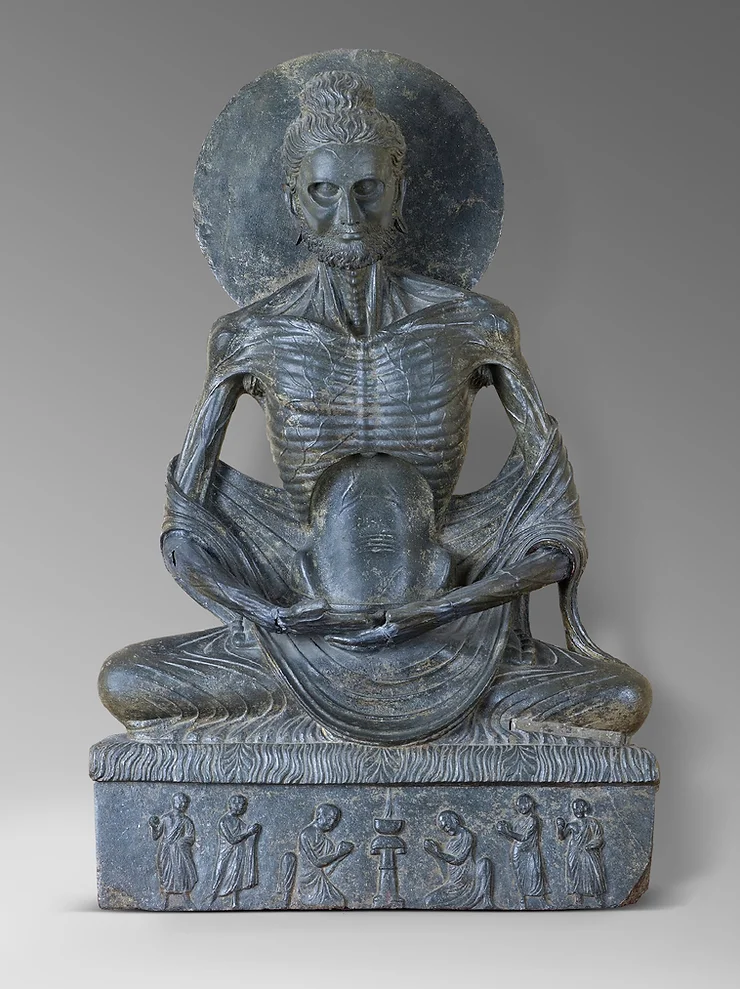
  <p>Our observations demonstrate that ancient Indian artists of the Gandhara region had a basic knowledge of human anatomy, especially surface anatomy and musculoskeletal features.
They also possessed knowledge of the approximate size and position of the bones, joints and muscles, including their approximate origin and insertion points.
However, certain errors of anatomical knowledge including an extra number of ribs and a segmented sternum were noticed.</p>
</blockquote>

<p>An anatomical review of a few Gandharan “Fasting” Buddha statues, including this one:</p>

<p><img src="/imgs/rdyy.webp" alt="emaciated" /></p>]]></content><author><name>Sreenivasulu Reddy Mogali</name></author><category term="articles" /><category term="history-of-medicine" /><category term="central-asian" /><category term="bart" /><summary type="html"><![CDATA[Our observations demonstrate that ancient Indian artists of the Gandhara region had a basic knowledge of human anatomy, especially surface anatomy and musculoskeletal features. They also possessed knowledge of the approximate size and position of the bones, joints and muscles, including their approximate origin and insertion points. However, certain errors of anatomical knowledge including an extra number of ribs and a segmented sternum were noticed.]]></summary></entry><entry><title type="html">Buddhist and Hindu Art in Mediaeval Maritime Asia</title><link href="https://buddhistuniversity.net/content/av/creative-south_acri-sharrock" rel="alternate" type="text/html" title="Buddhist and Hindu Art in Mediaeval Maritime Asia" /><published>2024-07-14T07:18:49+07:00</published><updated>2024-07-14T07:18:49+07:00</updated><id>https://buddhistuniversity.net/content/av/creative-south_acri-sharrock</id><content type="html" xml:base="https://buddhistuniversity.net/content/av/creative-south_acri-sharrock"><![CDATA[<p>How Southeast Asia didn’t just passively absorb Indian religions, but actively transformed them.</p>]]></content><author><name>Andrea Acri</name></author><category term="av" /><category term="bart" /><category term="sea-mahayana" /><category term="indic-religions" /><category term="medieval" /><summary type="html"><![CDATA[How Southeast Asia didn’t just passively absorb Indian religions, but actively transformed them.]]></summary></entry><entry><title type="html">The Nun of Milan: A Gandharan Bhikṣuṇī Figurine in the Civico Museo Archeologico</title><link href="https://buddhistuniversity.net/content/articles/nun-of-milan_dhammadina" rel="alternate" type="text/html" title="The Nun of Milan: A Gandharan Bhikṣuṇī Figurine in the Civico Museo Archeologico" /><published>2024-07-07T19:26:17+07:00</published><updated>2024-09-24T14:48:08+07:00</updated><id>https://buddhistuniversity.net/content/articles/nun-of-milan_dhammadina</id><content type="html" xml:base="https://buddhistuniversity.net/content/articles/nun-of-milan_dhammadina"><![CDATA[<blockquote>
  <p>… wearing only a <em>saṃkakṣikā</em>, because the latter appears not to cover the breasts completely, but only providing some support</p>
</blockquote>

<p>A Gandharan stucco figurine of a female Buddhist monk in the Civico Museo Archeologico in Milan, likely from Hadda around the second century AD, providing rare evidence of female monastics in Gandhāra and their attire.</p>]]></content><author><name>Bhikkhunī Dhammadinnā</name><uri>https://buddhistuniversity.net/authors/dhammadinna</uri></author><category term="articles" /><category term="bart" /><category term="central-asian" /><category term="nuns" /><category term="medieval" /><category term="sects" /><summary type="html"><![CDATA[… wearing only a saṃkakṣikā, because the latter appears not to cover the breasts completely, but only providing some support]]></summary></entry><entry><title type="html">The Big Buddhas Of Bamiyan</title><link href="https://buddhistuniversity.net/content/essays/big-buddhas-of-bamiyan_dhammika" rel="alternate" type="text/html" title="The Big Buddhas Of Bamiyan" /><published>2024-07-07T19:05:36+07:00</published><updated>2025-06-24T13:41:31+07:00</updated><id>https://buddhistuniversity.net/content/essays/big-buddhas-of-bamiyan_dhammika</id><content type="html" xml:base="https://buddhistuniversity.net/content/essays/big-buddhas-of-bamiyan_dhammika"><![CDATA[<blockquote>
  <p>The Taliban were by no means the first people to try to destroy the Buddhas. Islamic iconoclasts had
been hacking away at them for centuries. The Emperor Aurangzeb ordered cannons to blast the statues, as
did a Persian king in the 18th century. Both attempts damaged but did not destroy the statues.</p>
</blockquote>

<p>This essay is a brief history of and reflection on the giant Buddhas of Bamiyan.</p>]]></content><author><name>Bhante Shravasti Dhammika</name><uri>https://buddhistuniversity.net/authors/dhammika</uri></author><category term="essays" /><category term="bart" /><category term="central-asian" /><category term="medieval" /><summary type="html"><![CDATA[The Taliban were by no means the first people to try to destroy the Buddhas. Islamic iconoclasts had been hacking away at them for centuries. The Emperor Aurangzeb ordered cannons to blast the statues, as did a Persian king in the 18th century. Both attempts damaged but did not destroy the statues.]]></summary></entry><entry><title type="html">Standing out from the narrative in Theravādin art</title><link href="https://buddhistuniversity.net/content/papers/standing-out-narrative-in-theravadin-art_ashley-thompson" rel="alternate" type="text/html" title="Standing out from the narrative in Theravādin art" /><published>2024-06-17T09:07:41+07:00</published><updated>2025-05-28T16:11:48+07:00</updated><id>https://buddhistuniversity.net/content/papers/standing-out-narrative-in-theravadin-art_ashley-thompson</id><content type="html" xml:base="https://buddhistuniversity.net/content/papers/standing-out-narrative-in-theravadin-art_ashley-thompson"><![CDATA[<blockquote>
  <p>To see the image strictly as something to be seen is, in Skilling’s Buddhologist eyes, nothing less than to manifest ignorance…</p>
</blockquote>

<p>This book chapter examines the concept of “icons” within Theravāda Buddhism, drawing on narrative depictions. It argues that debates in art history regarding insider (emic) and outsider (etic) interpretations are crucial for understanding Southeast Asian perspectives on the Buddha. These perspectives grapple with the Buddha as both a historical figure and a representation of transcendent ideals.</p>]]></content><author><name>Ashley Thompson</name></author><category term="papers" /><category term="theravada-roots" /><category term="bart" /><category term="medieval" /><summary type="html"><![CDATA[To see the image strictly as something to be seen is, in Skilling’s Buddhologist eyes, nothing less than to manifest ignorance…]]></summary></entry><entry><title type="html">Along the Ancient Silk Routes: Central Asian Art from the West Berlin State Museums</title><link href="https://buddhistuniversity.net/content/monographs/along-the-ancient-silk-routes_hartel-herbert-yaldiz-marianne" rel="alternate" type="text/html" title="Along the Ancient Silk Routes: Central Asian Art from the West Berlin State Museums" /><published>2024-06-10T13:31:40+07:00</published><updated>2025-08-25T14:03:14+07:00</updated><id>https://buddhistuniversity.net/content/monographs/along-the-ancient-silk-routes_hartel-herbert-yaldiz-marianne</id><content type="html" xml:base="https://buddhistuniversity.net/content/monographs/along-the-ancient-silk-routes_hartel-herbert-yaldiz-marianne"><![CDATA[<blockquote>
  <p>The decision of a Buddhist council in favor of extensive missionary work outside India and the dispatch of monks to Afghanistan and Kashmir launched Buddhism’s development into a world religion. Thus, at the beginning of our era, Buddhist monks were wandering as missionaries through Central and Far East Asia.</p>
</blockquote>

<p>This is a catalog of a 1982 exhibit at the Metropolitan Museum of Art, with the pieces themselves dating from the 3rd century CE to the 10th century CE and now housed in the collections of the West Berlin State Museums. Also included is a scholarly introduction, giving a background to both the Silk Road and the movement of Buddhist art (and therefore Buddhism itself) through Central and East Asia.</p>]]></content><author><name>Herbert Härtel</name></author><category term="monographs" /><category term="bart" /><category term="central-asian" /><category term="mahayana-roots" /><category term="medieval" /><summary type="html"><![CDATA[The decision of a Buddhist council in favor of extensive missionary work outside India and the dispatch of monks to Afghanistan and Kashmir launched Buddhism’s development into a world religion. Thus, at the beginning of our era, Buddhist monks were wandering as missionaries through Central and Far East Asia.]]></summary></entry><entry><title type="html">Gaṇḍavyūha: The Quest for Awakening</title><link href="https://buddhistuniversity.net/content/monographs/gandavyuha-quest-for-awakening_anadajoti" rel="alternate" type="text/html" title="Gaṇḍavyūha: The Quest for Awakening" /><published>2024-05-27T12:33:53+07:00</published><updated>2024-09-24T14:48:08+07:00</updated><id>https://buddhistuniversity.net/content/monographs/gandavyuha-quest-for-awakening_anadajoti</id><content type="html" xml:base="https://buddhistuniversity.net/content/monographs/gandavyuha-quest-for-awakening_anadajoti"><![CDATA[<p>A bilingual guided tour of the Gaṇḍavyūha Reliefs at Borobudur in English and Indonesian.</p>

<p>For an academic discussion of this Mahayana Sutra and its parallels, see <a href="/content/articles/buddhalaksana-and-gandavyuha-sutra_levman">Levman’s 2005 article in CJBS</a>.</p>]]></content><author><name>Bhikkhu Ānandajoti</name><uri>https://buddhistuniversity.net/authors/anandajoti</uri></author><category term="monographs" /><category term="borobudur" /><category term="bart" /><category term="indonesian" /><category term="mahayana-roots" /><category term="rebirth-stories" /><summary type="html"><![CDATA[A bilingual guided tour of the Gaṇḍavyūha Reliefs at Borobudur in English and Indonesian.]]></summary></entry><entry><title type="html">Buddhist Spirituality and the Contemplation of Nature Through Poetry</title><link href="https://buddhistuniversity.net/content/av/buddhist-spirituality-and-contemplation-through-poetry_hallisey-charles" rel="alternate" type="text/html" title="Buddhist Spirituality and the Contemplation of Nature Through Poetry" /><published>2024-05-05T07:08:39+07:00</published><updated>2024-09-24T14:48:08+07:00</updated><id>https://buddhistuniversity.net/content/av/buddhist-spirituality-and-contemplation-through-poetry_hallisey-charles</id><content type="html" xml:base="https://buddhistuniversity.net/content/av/buddhist-spirituality-and-contemplation-through-poetry_hallisey-charles"><![CDATA[<blockquote>
  <p>Now, what we can say is that, it is within these spaces of practices of mental cultivation that poetry, in the Buddhist world, takes its place, as well as being part of literary culture; as well as being part of religious culture. But, it has a central place in the practice of mental cultivation. </p>
</blockquote>

<p>In this lecture, Professor Charles Hallisey describes how Buddhism has historically used poetry as a vehicle for its teachings. Further, through various examples, he offers the idea that, in the Buddhist world, scholatiscism and poetry are forms of mental cultivation as much as meditation and ritual and have always been so. </p>]]></content><author><name>Charles Hallisey</name><uri>https://buddhistuniversity.net/authors/hallisey-charles</uri></author><category term="av" /><category term="dialogue" /><category term="perception" /><category term="bart" /><category term="poetry" /><category term="canonical-poetry" /><category term="nature" /><category term="theravada-roots" /><summary type="html"><![CDATA[Now, what we can say is that, it is within these spaces of practices of mental cultivation that poetry, in the Buddhist world, takes its place, as well as being part of literary culture; as well as being part of religious culture. But, it has a central place in the practice of mental cultivation. ]]></summary></entry><entry><title type="html">Lost Kingdoms: Hindu-Buddhist Sculpture of Early Southeast Asia</title><link href="https://buddhistuniversity.net/content/monographs/lost-kingdoms-hindu-buddhist-sculpture_guy-john" rel="alternate" type="text/html" title="Lost Kingdoms: Hindu-Buddhist Sculpture of Early Southeast Asia" /><published>2024-04-08T12:30:57+07:00</published><updated>2025-11-09T19:13:24+07:00</updated><id>https://buddhistuniversity.net/content/monographs/lost-kingdoms-hindu-buddhist-sculpture_guy-john</id><content type="html" xml:base="https://buddhistuniversity.net/content/monographs/lost-kingdoms-hindu-buddhist-sculpture_guy-john"><![CDATA[<p>This exhibition catalog from The Met presents the religious sculptural arts of Southeast Asia from the 5th through the 8th centuries CE.</p>

<p>Not just a catalog of sculptures, the included essays by leading scholars explain much of what is known about the early history of Southeast Asian polities and their Indic religions.</p>]]></content><category term="monographs" /><category term="bart" /><category term="sea" /><category term="historiography" /><category term="theravada-roots" /><summary type="html"><![CDATA[This exhibition catalog from The Met presents the religious sculptural arts of Southeast Asia from the 5th through the 8th centuries CE.]]></summary></entry><entry><title type="html">The Making of a Saint: Images of Xuanzang in East Asia</title><link href="https://buddhistuniversity.net/content/articles/making-of-saint-images-of-xuanzang-in_wong-dorothy-c" rel="alternate" type="text/html" title="The Making of a Saint: Images of Xuanzang in East Asia" /><published>2024-04-08T07:24:20+07:00</published><updated>2024-11-12T10:51:57+07:00</updated><id>https://buddhistuniversity.net/content/articles/making-of-saint-images-of-xuanzang-in_wong-dorothy-c</id><content type="html" xml:base="https://buddhistuniversity.net/content/articles/making-of-saint-images-of-xuanzang-in_wong-dorothy-c"><![CDATA[<blockquote>
  <p>… this paper explores the processes by which he was transformed into a saintly figure. The manifold images of Xuanzang reflected the interaction and synthesis of Chinese and Indian Buddhist traditions that began during the early medieval period, further transformations when transmitted to other cultures, distinctions between elite and popular worship, and the intertwining of visualal and literary forms of [Buddhist] art.</p>
</blockquote>]]></content><author><name>Dorothy C. Wong</name></author><category term="articles" /><category term="bart" /><category term="east-asian-roots" /><category term="medieval" /><summary type="html"><![CDATA[… this paper explores the processes by which he was transformed into a saintly figure. The manifold images of Xuanzang reflected the interaction and synthesis of Chinese and Indian Buddhist traditions that began during the early medieval period, further transformations when transmitted to other cultures, distinctions between elite and popular worship, and the intertwining of visualal and literary forms of [Buddhist] art.]]></summary></entry><entry><title type="html">Cosmography in Southeast Asia</title><link href="https://buddhistuniversity.net/content/papers/cosmography-in-southeast-asia_schwartzberg-joseph-e" rel="alternate" type="text/html" title="Cosmography in Southeast Asia" /><published>2024-04-08T07:20:17+07:00</published><updated>2024-09-24T14:48:08+07:00</updated><id>https://buddhistuniversity.net/content/papers/cosmography-in-southeast-asia_schwartzberg-joseph-e</id><content type="html" xml:base="https://buddhistuniversity.net/content/papers/cosmography-in-southeast-asia_schwartzberg-joseph-e"><![CDATA[<p>Beginning with tribal beliefs and cosmologies, this paper explores how views of the universe in Southeast Asia have been presented in both geographical and artistic works over time. Other ideas that are elucidated include religious syncretism, particularly Buddhist and Hindu ideas, that come to inform Southeast Asian ideas of the universe and how such syncretism is mapped.</p>]]></content><author><name>Joseph E. Schwartzberg</name></author><category term="papers" /><category term="cosmology" /><category term="sea" /><category term="maps" /><category term="bart" /><category term="theravada-roots" /><summary type="html"><![CDATA[Beginning with tribal beliefs and cosmologies, this paper explores how views of the universe in Southeast Asia have been presented in both geographical and artistic works over time. Other ideas that are elucidated include religious syncretism, particularly Buddhist and Hindu ideas, that come to inform Southeast Asian ideas of the universe and how such syncretism is mapped.]]></summary></entry><entry><title type="html">Calligraphic Magic: Abhidhamma Inscriptions from Sukhodaya</title><link href="https://buddhistuniversity.net/content/articles/calligraphic-magic_skilling" rel="alternate" type="text/html" title="Calligraphic Magic: Abhidhamma Inscriptions from Sukhodaya" /><published>2024-02-14T20:53:28+07:00</published><updated>2025-07-27T18:51:16+07:00</updated><id>https://buddhistuniversity.net/content/articles/calligraphic-magic_skilling</id><content type="html" xml:base="https://buddhistuniversity.net/content/articles/calligraphic-magic_skilling"><![CDATA[<blockquote>
  <p>Two of these carry extracts from the Abhidhamma; the third gives a syllabary followed by the recollection formulas of the Three Gems.
The other two epigraphs are written not on stone slabs but are inscribed on small gold leaves; they contain the heart formulas of the books of the Tipiṭaka and the qualities of the Buddha, Dhamma, and Sangha.</p>
</blockquote>

<blockquote>
  <p>I suggest that they are the products of widespread and enduring Buddhist cultures of inscription, installation, and consecration, as well as of customs of condensation and abbreviation that have have been intrinsic to Thai liturgical and manuscript practices up to the present.</p>
</blockquote>]]></content><author><name>Peter Skilling</name><uri>https://buddhistuniversity.net/authors/skilling</uri></author><category term="articles" /><category term="thai-roots" /><category term="roots" /><category term="writing" /><category term="bart" /><category term="theravada-roots" /><summary type="html"><![CDATA[Two of these carry extracts from the Abhidhamma; the third gives a syllabary followed by the recollection formulas of the Three Gems. The other two epigraphs are written not on stone slabs but are inscribed on small gold leaves; they contain the heart formulas of the books of the Tipiṭaka and the qualities of the Buddha, Dhamma, and Sangha.]]></summary></entry><entry><title type="html">Beginnings</title><link href="https://buddhistuniversity.net/content/av/beginnings_sujato" rel="alternate" type="text/html" title="Beginnings" /><published>2024-02-02T08:01:34+07:00</published><updated>2024-09-24T14:48:08+07:00</updated><id>https://buddhistuniversity.net/content/av/beginnings_sujato</id><content type="html" xml:base="https://buddhistuniversity.net/content/av/beginnings_sujato"><![CDATA[<p><a href="/content/canon/dn27">The Aggañña Sutta</a> retold as a trippy “children’s” tale.</p>]]></content><author><name>Bhante Sujato</name><uri>https://buddhistuniversity.net/authors/sujato</uri></author><category term="av" /><category term="myth" /><category term="bart" /><category term="modern" /><category term="cosmology" /><summary type="html"><![CDATA[The Aggañña Sutta retold as a trippy “children’s” tale.]]></summary></entry><entry><title type="html">Pedestrian Dharma: Slowness and Seeing in Tsai Ming-Liang’s Walker</title><link href="https://buddhistuniversity.net/content/articles/pedestrian-dharma-slowness-and-seeing-in_ng-teng-kuan" rel="alternate" type="text/html" title="Pedestrian Dharma: Slowness and Seeing in Tsai Ming-Liang’s Walker" /><published>2023-12-30T19:20:44+07:00</published><updated>2025-10-20T16:26:40+07:00</updated><id>https://buddhistuniversity.net/content/articles/pedestrian-dharma-slowness-and-seeing-in_ng-teng-kuan</id><content type="html" xml:base="https://buddhistuniversity.net/content/articles/pedestrian-dharma-slowness-and-seeing-in_ng-teng-kuan"><![CDATA[<blockquote>
  <p>To present slowness and simplicity as prophetic counterpoints against the dizzying excesses of the contemporary metropolis; and to offer contemplative attentiveness as a therapeutic resource for life in the modern world.</p>
</blockquote>

<blockquote>
  <p>This paper studies the ways that Walker, a short film by the Malaysian-Taiwanese auteur Tsai Ming-Liang, visualizes the relationship between Buddhism and modernity.</p>
</blockquote>

<p>You can also watch on YouTube:</p>
<ul>
  <li><a href="https://youtu.be/wakr9i2E-88">a clip from the film discussed in this article</a></li>
  <li><a href="https://youtu.be/0HGv3ItyTIY">a sped-up version of another film from the series</a></li>
  <li>and <a href="https://youtu.be/7G6e5CR2ahI">an interview with Ng about this article</a></li>
</ul>]]></content><author><name>Teng-Kuan Ng</name></author><category term="articles" /><category term="film" /><category term="walking" /><category term="modern" /><category term="cities" /><category term="bart" /><summary type="html"><![CDATA[To present slowness and simplicity as prophetic counterpoints against the dizzying excesses of the contemporary metropolis; and to offer contemplative attentiveness as a therapeutic resource for life in the modern world.]]></summary></entry><entry><title type="html">Seeds Used for Bodhi Beads in China</title><link href="https://buddhistuniversity.net/content/articles/seeds-used-for-bodhi-beads-in-china_li-feifei-et-al" rel="alternate" type="text/html" title="Seeds Used for Bodhi Beads in China" /><published>2023-11-26T19:59:28+07:00</published><updated>2024-09-24T14:48:08+07:00</updated><id>https://buddhistuniversity.net/content/articles/seeds-used-for-bodhi-beads-in-china_li-feifei-et-al</id><content type="html" xml:base="https://buddhistuniversity.net/content/articles/seeds-used-for-bodhi-beads-in-china_li-feifei-et-al"><![CDATA[<blockquote>
  <p>Ethnobotanical surveys were conducted in six provinces of China to investigate and document Bodhi bead plants.</p>
</blockquote>

<blockquote>
  <p>Forty-seven species in 19 families and 39 genera represented 52 types of Bodhi beads that were collected.
The most popular Bodhi bead plants have a long history and religious significance.
Most Bodhi bead plants can be used as medicine or food, and their seeds or fruits are the main elements in these uses.</p>
</blockquote>]]></content><author><name>Feifei Li</name></author><category term="articles" /><category term="mahayana" /><category term="bart" /><category term="plants" /><category term="chinese" /><summary type="html"><![CDATA[Ethnobotanical surveys were conducted in six provinces of China to investigate and document Bodhi bead plants.]]></summary></entry><entry><title type="html">Performing Mind, Writing Meditation: Dōgen’s Fukanzazengi as Zen Calligraphy</title><link href="https://buddhistuniversity.net/content/articles/performing-mind-writing-meditation_eubanks-charlotte" rel="alternate" type="text/html" title="Performing Mind, Writing Meditation: Dōgen’s Fukanzazengi as Zen Calligraphy" /><published>2023-11-16T16:18:27+07:00</published><updated>2024-09-24T14:48:08+07:00</updated><id>https://buddhistuniversity.net/content/articles/performing-mind-writing-meditation_eubanks-charlotte</id><content type="html" xml:base="https://buddhistuniversity.net/content/articles/performing-mind-writing-meditation_eubanks-charlotte"><![CDATA[<blockquote>
  <p>Dōgen’s calligraphy is a carefully orchestrated performance. That is, it does precisely what it asks its readers to do: it sits calmly, evenly, and at poised attention in a real-world field of objects. The manuscript’s brushstrokes and entire aesthetic layout enact seated meditation.</p>
</blockquote>

<blockquote>
  <p>The <em>Fukanzazengi</em> falls into a completely different genre of Zen writing from the sorts of expressive and creative manifestations, much-favored in museum exhibitions, in which dynamic interpretation is paramount. Instead, the Fukanzazengi is a pedagogical and didactic guide in which legibility is crucial, the function being to teach adherents, clearly and methodically, how to do seated meditation. In support of this assertion, I offer an extended visual analysis of the performativity of the manuscript’s calm and measured calligraphy.</p>
</blockquote>]]></content><author><name>Charlotte Eubanks</name></author><category term="articles" /><category term="bart" /><category term="zen" /><category term="writing" /><category term="east-asian" /><summary type="html"><![CDATA[Dōgen’s calligraphy is a carefully orchestrated performance. That is, it does precisely what it asks its readers to do: it sits calmly, evenly, and at poised attention in a real-world field of objects. The manuscript’s brushstrokes and entire aesthetic layout enact seated meditation.]]></summary><media:thumbnail xmlns:media="http://search.yahoo.com/mrss/" url="https://quod.lib.umich.edu/a/ars/images/13441566.0046.007-01.jpg" /><media:content medium="image" url="https://quod.lib.umich.edu/a/ars/images/13441566.0046.007-01.jpg" xmlns:media="http://search.yahoo.com/mrss/" /></entry><entry><title type="html">Colossal Buddha Statues along the Silk Road</title><link href="https://buddhistuniversity.net/content/articles/colossal-buddha-statues-along-silk-road_wong-dorothy-c" rel="alternate" type="text/html" title="Colossal Buddha Statues along the Silk Road" /><published>2023-11-04T19:53:03+07:00</published><updated>2026-02-14T16:45:19+07:00</updated><id>https://buddhistuniversity.net/content/articles/colossal-buddha-statues-along-silk-road_wong-dorothy-c</id><content type="html" xml:base="https://buddhistuniversity.net/content/articles/colossal-buddha-statues-along-silk-road_wong-dorothy-c"><![CDATA[<blockquote>
  <p>Beginning in the northwestern region of India, and spreading through Central Asia and the rest of Asia along the Silk Road, the making of colossal Buddha statues has been a major theme in Buddhist art.
The colossal Buddha statues predominantly feature Śākyamuni (the Historical Buddha), Maitreya (the Future Buddha), and Vairocana (the Transcendant Buddha), and they were fashioned out of religious devotion and frequently in conjunction with notions of Buddhist kingship.
This paper examines the religious, social and political circumstances under which these colossal statues were made, focusing on examples from Central and East Asia made during the first millennium CE.
Beginning in the 1990s, there was a revival of making colossal Buddha statues across China and elsewhere.
The paper also briefly compares the current wave of building colossal Buddha statues with historical examples.</p>
</blockquote>]]></content><author><name>Dorothy C. Wong</name></author><category term="articles" /><category term="medieval" /><category term="mahayana-roots" /><category term="bart" /><summary type="html"><![CDATA[Beginning in the northwestern region of India, and spreading through Central Asia and the rest of Asia along the Silk Road, the making of colossal Buddha statues has been a major theme in Buddhist art. The colossal Buddha statues predominantly feature Śākyamuni (the Historical Buddha), Maitreya (the Future Buddha), and Vairocana (the Transcendant Buddha), and they were fashioned out of religious devotion and frequently in conjunction with notions of Buddhist kingship. This paper examines the religious, social and political circumstances under which these colossal statues were made, focusing on examples from Central and East Asia made during the first millennium CE. Beginning in the 1990s, there was a revival of making colossal Buddha statues across China and elsewhere. The paper also briefly compares the current wave of building colossal Buddha statues with historical examples.]]></summary></entry><entry><title type="html">Ethnicity and identity: Northern nomads as Buddhist art patrons during the period of Northern and Southern dynasties</title><link href="https://buddhistuniversity.net/content/papers/ethnicity-identity_wong-dorothy" rel="alternate" type="text/html" title="Ethnicity and identity: Northern nomads as Buddhist art patrons during the period of Northern and Southern dynasties" /><published>2023-10-25T12:35:33+07:00</published><updated>2024-09-24T14:48:08+07:00</updated><id>https://buddhistuniversity.net/content/papers/ethnicity-identity_wong-dorothy</id><content type="html" xml:base="https://buddhistuniversity.net/content/papers/ethnicity-identity_wong-dorothy"><![CDATA[<blockquote>
  <p>Despite being cultural aliens, the nomads were aware of the superior literary and cultural tradition of the Chinese with whom they came into contact.
Accepting the Confucian tradition and Chinese ways, however, would have meant subsuming their military superiority to and separateness from those they conquered.
Instead, most nomadic rulers chose to adopt Buddhism as an alternative cultural policy.</p>
</blockquote>]]></content><author><name>Dorothy C. Wong</name></author><category term="papers" /><category term="east-asian-roots" /><category term="bart" /><category term="race" /><category term="intercultural" /><category term="roots" /><summary type="html"><![CDATA[Despite being cultural aliens, the nomads were aware of the superior literary and cultural tradition of the Chinese with whom they came into contact. Accepting the Confucian tradition and Chinese ways, however, would have meant subsuming their military superiority to and separateness from those they conquered. Instead, most nomadic rulers chose to adopt Buddhism as an alternative cultural policy.]]></summary></entry><entry><title type="html">Ud 2.1 Mucalinda Sutta: With Mucalinda</title><link href="https://buddhistuniversity.net/content/canon/ud2.1" rel="alternate" type="text/html" title="Ud 2.1 Mucalinda Sutta: With Mucalinda" /><published>2023-10-25T12:35:33+07:00</published><updated>2025-11-24T12:31:06+07:00</updated><id>https://buddhistuniversity.net/content/canon/ud2.1</id><content type="html" xml:base="https://buddhistuniversity.net/content/canon/ud2.1"><![CDATA[<blockquote>
  <p>May the Buddha not be hot or cold, nor be bothered by flies …</p>
</blockquote>

<p>Shortly after the Buddha’s awakening, <a href="https://en.wikipedia.org/wiki/Mucalinda">Nāga Mucalinda</a> protects him from a storm—a striking image that would <a href="https://www.metmuseum.org/art/collection/search/39100">inspire artists</a> for thousands of years.</p>]]></content><author><name>Bhante Sujato</name><uri>https://buddhistuniversity.net/authors/sujato</uri></author><category term="canon" /><category term="bart" /><category term="ud" /><category term="theravada-roots" /><summary type="html"><![CDATA[May the Buddha not be hot or cold, nor be bothered by flies …]]></summary></entry><entry><title type="html">Until Nirvana’s Time: Buddhist Songs from Cambodia</title><link href="https://buddhistuniversity.net/content/av/until-nirvanas-time_walker-trent" rel="alternate" type="text/html" title="Until Nirvana’s Time: Buddhist Songs from Cambodia" /><published>2023-10-25T12:35:33+07:00</published><updated>2025-03-24T20:27:35+07:00</updated><id>https://buddhistuniversity.net/content/av/until-nirvanas-time_walker-trent</id><content type="html" xml:base="https://buddhistuniversity.net/content/av/until-nirvanas-time_walker-trent"><![CDATA[<p>On taking seriously the study of the vernacular, Theravāda arts and what they tell us about pre-modern Buddhism in Southeast Asia.</p>]]></content><author><name>Trent Walker</name><uri>https://buddhistuniversity.net/authors/walker-trent</uri></author><category term="av" /><category term="bart" /><category term="theravada" /><category term="music" /><category term="academic" /><category term="roots" /><summary type="html"><![CDATA[On taking seriously the study of the vernacular, Theravāda arts and what they tell us about pre-modern Buddhism in Southeast Asia.]]></summary></entry><entry><title type="html">SN 4.25 Māradhītu Sutta: Māra’s Daughters</title><link href="https://buddhistuniversity.net/content/canon/sn4.25" rel="alternate" type="text/html" title="SN 4.25 Māradhītu Sutta: Māra’s Daughters" /><published>2023-10-09T12:27:34+07:00</published><updated>2024-09-24T14:48:08+07:00</updated><id>https://buddhistuniversity.net/content/canon/sn.004.025</id><content type="html" xml:base="https://buddhistuniversity.net/content/canon/sn4.25"><![CDATA[<blockquote>
  <p>They had come to him glittering with beauty—<br />
Taṇha, Arati, and Raga—<br />
But the Teacher swept them away right there<br />
As the wind, a fallen cotton tuft.</p>
</blockquote>

<p>Depressed, Māra laments to his three daughters of his failure to distract the Buddha.
So they take on the task themselves and assume a variety of sensuous forms to tempt him.
But they fail too, and Māra castigates them for being so presumptuous</p>]]></content><author><name>Bhikkhu Bodhi</name><uri>https://buddhistuniversity.net/authors/bodhi</uri></author><category term="canon" /><category term="bart" /><category term="sn" /><category term="canonical-poetry" /><summary type="html"><![CDATA[They had come to him glittering with beauty— Taṇha, Arati, and Raga— But the Teacher swept them away right there As the wind, a fallen cotton tuft.]]></summary></entry><entry><title type="html">The Shape of Victory: the Earth-Touching Gesture in Context</title><link href="https://buddhistuniversity.net/content/articles/shape-of-victory_smith-doug" rel="alternate" type="text/html" title="The Shape of Victory: the Earth-Touching Gesture in Context" /><published>2023-07-27T16:20:10+07:00</published><updated>2024-11-12T10:51:57+07:00</updated><id>https://buddhistuniversity.net/content/articles/shape-of-victory_smith-doug</id><content type="html" xml:base="https://buddhistuniversity.net/content/articles/shape-of-victory_smith-doug"><![CDATA[<blockquote>
  <p>There is no story of Gotama having touched the ground before his awakening in the earliest Buddhist texts describing these events</p>
</blockquote>]]></content><author><name>Doug Smith</name><uri>https://buddhistuniversity.net/authors/smith-doug</uri></author><category term="articles" /><category term="bart" /><category term="buddha" /><summary type="html"><![CDATA[There is no story of Gotama having touched the ground before his awakening in the earliest Buddhist texts describing these events]]></summary></entry><entry><title type="html">The identification of plant reliefs in the Lalitavistara story of Borobudur temple, Central Java, Indonesia</title><link href="https://buddhistuniversity.net/content/articles/plant-reliefs-at-borobudur_metusala-et-al" rel="alternate" type="text/html" title="The identification of plant reliefs in the Lalitavistara story of Borobudur temple, Central Java, Indonesia" /><published>2023-04-19T19:12:33+07:00</published><updated>2024-11-02T22:50:39+07:00</updated><id>https://buddhistuniversity.net/content/articles/plant-reliefs-at-borobudur_metusala-et-al</id><content type="html" xml:base="https://buddhistuniversity.net/content/articles/plant-reliefs-at-borobudur_metusala-et-al"><![CDATA[<blockquote>
  <p>The Lalitavistara sutra is one of the central texts in the Mahayana tradition and it describes the life of the Buddha.</p>
</blockquote>

<p>Deals with the various species of plants found in the Borobudur releifs, showing the care and detail taken in including aspects of nature in Buddhist reliefs.</p>]]></content><author><name>Destario Metusala</name></author><category term="articles" /><category term="bart" /><category term="plants" /><category term="indonesian" /><category term="nature" /><summary type="html"><![CDATA[The Lalitavistara sutra is one of the central texts in the Mahayana tradition and it describes the life of the Buddha.]]></summary></entry><entry><title type="html">Tai Khun Buddhism And Ethnic-Religious Identity</title><link href="https://buddhistuniversity.net/content/articles/tai-khun-buddhism-and-ethnic-religious_karlsson-klemens" rel="alternate" type="text/html" title="Tai Khun Buddhism And Ethnic-Religious Identity" /><published>2023-04-11T13:58:35+07:00</published><updated>2024-09-24T14:48:08+07:00</updated><id>https://buddhistuniversity.net/content/articles/tai-khun-buddhism-and-ethnic-religious_karlsson-klemens</id><content type="html" xml:base="https://buddhistuniversity.net/content/articles/tai-khun-buddhism-and-ethnic-religious_karlsson-klemens"><![CDATA[<blockquote>
  <p>… the history, myth and cult of a Burmese Buddha image standing in the middle of the [Shan] city of Chiang Tung and the ways in which religious visual culture expresses ethnic-religious identity.</p>
</blockquote>

<p>Religious art, as a symbol of culture, is inevitably political.
And yet, for whatever reasons an icon might be installed, it’s only a matter of time before it becomes adopted by its hosts.</p>]]></content><author><name>Klemens Karlsson</name></author><category term="articles" /><category term="theravada" /><category term="shan" /><category term="architecture" /><category term="roots" /><category term="social" /><category term="culture" /><category term="bart" /><summary type="html"><![CDATA[… the history, myth and cult of a Burmese Buddha image standing in the middle of the [Shan] city of Chiang Tung and the ways in which religious visual culture expresses ethnic-religious identity.]]></summary></entry><entry><title type="html">The Light-Emitting Image of Magadha in Tang Buddhist Art</title><link href="https://buddhistuniversity.net/content/articles/light-emitting-image-of-magadha-in-tang_wong-dorothy" rel="alternate" type="text/html" title="The Light-Emitting Image of Magadha in Tang Buddhist Art" /><published>2023-03-30T17:32:46+07:00</published><updated>2024-11-12T10:51:57+07:00</updated><id>https://buddhistuniversity.net/content/articles/light-emitting-image-of-magadha-in-tang_wong-dorothy</id><content type="html" xml:base="https://buddhistuniversity.net/content/articles/light-emitting-image-of-magadha-in-tang_wong-dorothy"><![CDATA[<blockquote>
  <p>As a sacred site for pilgrimage, Bodhgayā became even more prominent from the sixth and seventh centuries onward, when the rebuilding of the Mahābodhi Temple coincided with the installation of a Buddha statue with the earth-touching gesture, symbolic of the Buddha’s calling upon the earth to bear witness to his victory over evil.
Miracles enshroud the creation of the image itself, and later it became a famous icon widely copied throughout the Buddhist world.</p>
</blockquote>

<blockquote>
  <p>This essay investigates the image’s origins and its dissemination to China.
Further, it argues that the legends surrounding the image that developed in China contributed to Chinese pilgrims visiting India to pay homage to the site and the sacred statue, and to seek experiences of the numinous and validation of their piety.
In turn they brought replicas of the statue back to China, contributing to the spread of the image type.
Pilgrims’ accounts of miracle-performing images and their depictions in visual forms affirm, to the pious, the efficacy of the divinities, not seen as separate from their material forms</p>
</blockquote>]]></content><author><name>Dorothy C. Wong</name></author><category term="articles" /><category term="pilgrimage" /><category term="east-asian-roots" /><category term="bart" /><category term="medieval" /><summary type="html"><![CDATA[As a sacred site for pilgrimage, Bodhgayā became even more prominent from the sixth and seventh centuries onward, when the rebuilding of the Mahābodhi Temple coincided with the installation of a Buddha statue with the earth-touching gesture, symbolic of the Buddha’s calling upon the earth to bear witness to his victory over evil. Miracles enshroud the creation of the image itself, and later it became a famous icon widely copied throughout the Buddhist world.]]></summary></entry><entry><title type="html">Hypostasizing the Buddha: Buddha Image Consecration in Northern Thailand</title><link href="https://buddhistuniversity.net/content/articles/hypostasizing-buddha-buddha-image_swearer-donald-k" rel="alternate" type="text/html" title="Hypostasizing the Buddha: Buddha Image Consecration in Northern Thailand" /><published>2023-01-24T21:29:17+07:00</published><updated>2024-09-24T14:48:08+07:00</updated><id>https://buddhistuniversity.net/content/articles/hypostasizing-buddha-buddha-image_swearer-donald-k</id><content type="html" xml:base="https://buddhistuniversity.net/content/articles/hypostasizing-buddha-buddha-image_swearer-donald-k"><![CDATA[<p>A description of the Chiang Mai Buddha-image consecration ceremony alongside some musings on what it all might “mean.”</p>]]></content><author><name>Donald K. Swearer</name></author><category term="articles" /><category term="bart" /><category term="theravada" /><summary type="html"><![CDATA[A description of the Chiang Mai Buddha-image consecration ceremony alongside some musings on what it all might “mean.”]]></summary></entry><entry><title type="html">The Greatest Man Who Ever Lived: The Supreme Buddha</title><link href="https://buddhistuniversity.net/content/booklets/greatest-man_weragoda-sarada" rel="alternate" type="text/html" title="The Greatest Man Who Ever Lived: The Supreme Buddha" /><published>2023-01-23T21:24:36+07:00</published><updated>2025-05-24T13:54:56+07:00</updated><id>https://buddhistuniversity.net/content/booklets/greatest-man_weragoda-sarada</id><content type="html" xml:base="https://buddhistuniversity.net/content/booklets/greatest-man_weragoda-sarada"><![CDATA[<p>An exuberant, illustrated biography of the Buddha.</p>]]></content><author><name>Weragoda Sarada</name></author><category term="booklets" /><category term="buddha" /><category term="bart" /><summary type="html"><![CDATA[An exuberant, illustrated biography of the Buddha.]]></summary></entry><entry><title type="html">The Japanese Buddhist World Map</title><link href="https://buddhistuniversity.net/content/av/japanese-world-map_moerman-max" rel="alternate" type="text/html" title="The Japanese Buddhist World Map" /><published>2022-09-30T21:35:07+07:00</published><updated>2025-05-28T15:54:41+07:00</updated><id>https://buddhistuniversity.net/content/av/japanese-world-map_moerman-max</id><content type="html" xml:base="https://buddhistuniversity.net/content/av/japanese-world-map_moerman-max"><![CDATA[<p>The 500-year history of world maps in Buddhist Japan and what these maps tell us about the Japanese, Buddhist identity.</p>

<p>This interview explores David Max Moerman’s study of the largely unknown history of Japanese, Buddhist world maps.
His work uncovers an alternative history of Japanese Buddhism shaped by a Buddhist geographic imaginary that engaged multiple cartographic and cosmological worldviews.</p>]]></content><author><name>Max Moerman</name></author><category term="av" /><category term="maps" /><category term="medieval" /><category term="dialogue" /><category term="bart" /><category term="japanese" /><summary type="html"><![CDATA[The 500-year history of world maps in Buddhist Japan and what these maps tell us about the Japanese, Buddhist identity.]]></summary></entry><entry><title type="html">He’s Still Neutral</title><link href="https://buddhistuniversity.net/content/av/still-neutral_criminal" rel="alternate" type="text/html" title="He’s Still Neutral" /><published>2022-09-08T20:02:10+07:00</published><updated>2022-09-08T20:02:10+07:00</updated><id>https://buddhistuniversity.net/content/av/still-neutral_criminal</id><content type="html" xml:base="https://buddhistuniversity.net/content/av/still-neutral_criminal"><![CDATA[<blockquote>
  <p>Because he’s neutral. I mean if we threw Christ up there, he is controversial. Everybody has got a deal about him. But Buddha, nobody seems to be that perturbed about a Buddha.</p>
</blockquote>]]></content><author><name>Phoebe Judge</name></author><category term="av" /><category term="bart" /><category term="vietnamese" /><category term="migration" /><category term="cities" /><category term="west" /><summary type="html"><![CDATA[Because he’s neutral. I mean if we threw Christ up there, he is controversial. Everybody has got a deal about him. But Buddha, nobody seems to be that perturbed about a Buddha.]]></summary></entry><entry><title type="html">Six Persimmons</title><link href="https://buddhistuniversity.net/content/av/six-persimmons_cahill-james" rel="alternate" type="text/html" title="Six Persimmons" /><published>2022-05-22T20:02:11+07:00</published><updated>2024-09-24T14:48:08+07:00</updated><id>https://buddhistuniversity.net/content/av/six-persimmons_cahill-james</id><content type="html" xml:base="https://buddhistuniversity.net/content/av/six-persimmons_cahill-james"><![CDATA[<blockquote>
  <p>What can one possibly say about [this painting]? One can only sit in front of it, gazing at it in silent wonder.</p>
</blockquote>

<p>A scholar of Chinese painting attempts to explain this famously ineffable Ch’an still life.</p>]]></content><author><name>James Cahill</name></author><category term="av" /><category term="bart" /><category term="east-asian" /><summary type="html"><![CDATA[What can one possibly say about [this painting]? One can only sit in front of it, gazing at it in silent wonder.]]></summary></entry><entry><title type="html">Ritual in Contemplation: Text and Tools in Tantric Buddhism</title><link href="https://buddhistuniversity.net/content/av/ritual-in-contemplation_thurman-robert" rel="alternate" type="text/html" title="Ritual in Contemplation: Text and Tools in Tantric Buddhism" /><published>2022-05-19T21:11:11+07:00</published><updated>2025-05-04T18:40:26+07:00</updated><id>https://buddhistuniversity.net/content/av/ritual-in-contemplation_thurman-robert</id><content type="html" xml:base="https://buddhistuniversity.net/content/av/ritual-in-contemplation_thurman-robert"><![CDATA[<blockquote>
  <p>Tantric Buddhist art helps people to imagine a world they do not yet experience and to jolt them out of their habitual experience of the world</p>
</blockquote>

<p>An introduction to Tantric Buddhist art and how tantric practices connect to the Buddhist path.</p>]]></content><author><name>Robert Thurman</name></author><category term="av" /><category term="bart" /><category term="tibetan" /><category term="tantric" /><summary type="html"><![CDATA[Tantric Buddhist art helps people to imagine a world they do not yet experience and to jolt them out of their habitual experience of the world]]></summary></entry><entry><title type="html">Mudrās</title><link href="https://buddhistuniversity.net/content/essays/mudras_del-prado" rel="alternate" type="text/html" title="Mudrās" /><published>2022-05-08T23:54:45+07:00</published><updated>2024-09-24T14:48:08+07:00</updated><id>https://buddhistuniversity.net/content/essays/mudras_del-prado</id><content type="html" xml:base="https://buddhistuniversity.net/content/essays/mudras_del-prado"><![CDATA[<blockquote>
  <p>Buddhas and Bodisattvas and frequently other deities are shown with their hands forming a number of different ritualized and stylized poses (Mudrās).</p>
</blockquote>]]></content><author><name>Villa Del Prado</name></author><category term="essays" /><category term="bart" /><category term="tantric" /><summary type="html"><![CDATA[Buddhas and Bodisattvas and frequently other deities are shown with their hands forming a number of different ritualized and stylized poses (Mudrās).]]></summary></entry><entry><title type="html">Embodying Compassion in Buddhist Art: Image, Pilgrimage, Practice</title><link href="https://buddhistuniversity.net/content/monographs/embodying-compassion-in-buddhist-art_lucic-karen" rel="alternate" type="text/html" title="Embodying Compassion in Buddhist Art: Image, Pilgrimage, Practice" /><published>2022-04-05T20:57:31+07:00</published><updated>2024-11-11T15:12:52+07:00</updated><id>https://buddhistuniversity.net/content/monographs/embodying-compassion-in-buddhist-art_lucic-karen</id><content type="html" xml:base="https://buddhistuniversity.net/content/monographs/embodying-compassion-in-buddhist-art_lucic-karen"><![CDATA[<blockquote>
  <p>Up until the middle of the first millennium, Avalokiteshvara consistently appeared in a magnificent, idealized body, yet one in accord with human norms. But sometime around the 6th century, an iconographic revolution occurred in Indian art, and he began to acquire additional arms, heads, and eyes.</p>
</blockquote>

<p>An introduction to the history of Avalokiteshvara through Buddhist art.</p>]]></content><author><name>Karen Lucic</name></author><category term="monographs" /><category term="bart" /><category term="bodhisattva" /><category term="mahayana" /><summary type="html"><![CDATA[Up until the middle of the first millennium, Avalokiteshvara consistently appeared in a magnificent, idealized body, yet one in accord with human norms. But sometime around the 6th century, an iconographic revolution occurred in Indian art, and he began to acquire additional arms, heads, and eyes.]]></summary></entry><entry><title type="html">The Lotus Transcendent: Indian and Southeast Asian Art from the Samuel Eilenberg Collection</title><link href="https://buddhistuniversity.net/content/monographs/lotus-transcendent" rel="alternate" type="text/html" title="The Lotus Transcendent: Indian and Southeast Asian Art from the Samuel Eilenberg Collection" /><published>2022-04-02T11:39:43+07:00</published><updated>2025-05-04T18:40:26+07:00</updated><id>https://buddhistuniversity.net/content/monographs/lotus-transcendent</id><content type="html" xml:base="https://buddhistuniversity.net/content/monographs/lotus-transcendent"><![CDATA[<p>A collection of mostly Buddhist artwork from across premodern South Asia and India’s cultural sphere.</p>]]></content><author><name>Martin Lerner</name></author><category term="monographs" /><category term="form" /><category term="mahayana-roots" /><category term="sea-mahayana" /><category term="bart" /><category term="indonesian" /><summary type="html"><![CDATA[A collection of mostly Buddhist artwork from across premodern South Asia and India’s cultural sphere.]]></summary></entry><entry><title type="html">The Buddha on the Alter of Drepung Loseling Monastery</title><link href="https://buddhistuniversity.net/content/av/drepung-loseling-buddha" rel="alternate" type="text/html" title="The Buddha on the Alter of Drepung Loseling Monastery" /><published>2022-02-26T07:12:12+07:00</published><updated>2024-11-21T19:03:04+07:00</updated><id>https://buddhistuniversity.net/content/av/drepung-loseling-buddha</id><content type="html" xml:base="https://buddhistuniversity.net/content/av/drepung-loseling-buddha"><![CDATA[<p>A very short video, explaining the symbolism behind a common, Tibetan Buddha statue.</p>]]></content><author><name>Dadul Namgyal</name></author><category term="av" /><category term="tibetan" /><category term="bart" /><category term="form" /><summary type="html"><![CDATA[A very short video, explaining the symbolism behind a common, Tibetan Buddha statue.]]></summary></entry><entry><title type="html">Buddhism Goes to the Movies: An Introduction to Buddhist Thought and Practice</title><link href="https://buddhistuniversity.net/content/monographs/buddhism-goes-to-the-movies_green-ronald" rel="alternate" type="text/html" title="Buddhism Goes to the Movies: An Introduction to Buddhist Thought and Practice" /><published>2022-02-24T09:51:24+07:00</published><updated>2025-11-01T15:20:54+07:00</updated><id>https://buddhistuniversity.net/content/monographs/buddhism-goes-to-the-movies_green-ronald</id><content type="html" xml:base="https://buddhistuniversity.net/content/monographs/buddhism-goes-to-the-movies_green-ronald"><![CDATA[<blockquote>
  <p>This book describes the basics of Buddhist philosophy and practice within the contexts of a number of dramatic, not documentary, films. It introduces some of the main traditions of Buddhism. Little or no knowledge of Buddhism is assumed of the reader. Instead, Buddhist concepts, practices, and histories are presented in progression so that this might serve as an introduction to Buddhism particularly accessible to those interested in film.</p>
</blockquote>]]></content><author><name>Ronald Green</name></author><category term="monographs" /><category term="film" /><category term="form" /><category term="west" /><category term="bart" /><summary type="html"><![CDATA[This book describes the basics of Buddhist philosophy and practice within the contexts of a number of dramatic, not documentary, films. It introduces some of the main traditions of Buddhism. Little or no knowledge of Buddhism is assumed of the reader. Instead, Buddhist concepts, practices, and histories are presented in progression so that this might serve as an introduction to Buddhism particularly accessible to those interested in film.]]></summary></entry><entry><title type="html">Spring, Summer, Fall, Winter… and Spring</title><link href="https://buddhistuniversity.net/content/av/spring-summer-fall-winter-spring" rel="alternate" type="text/html" title="Spring, Summer, Fall, Winter… and Spring" /><published>2021-12-16T12:16:06+07:00</published><updated>2025-11-07T19:49:58+07:00</updated><id>https://buddhistuniversity.net/content/av/spring-summer-fall-winter-spring</id><content type="html" xml:base="https://buddhistuniversity.net/content/av/spring-summer-fall-winter-spring"><![CDATA[<blockquote>
  <p>Didn’t you know beforehand how the world of men is? Sometimes we have to let go of the things we like.</p>
</blockquote>

<p>An orphaned boy is raised by an old hermit on a small barge in the middle of a scenic, mountain lake where he learns about the cycle of life and death.</p>

<p>For an overview of critical interpretations of the film’s symbolism, see <a href="https://drive.google.com/file/d/10tJdaWzVyPklGHr6mpJxqoivF9bimfj-/view?usp=drivesdk" target="_blank" ga-event-value="0.5">Green and Mun’s 2019 article, “Representing Buddhism through Mise-en-scène, Diegesis, and Mimesis” (IJBTC 29.1)</a>.</p>]]></content><author><name>Kim Ki-duk</name></author><category term="av" /><category term="east-asian" /><category term="korea" /><category term="bart" /><category term="cosmology" /><category term="world" /><summary type="html"><![CDATA[Didn’t you know beforehand how the world of men is? Sometimes we have to let go of the things we like.]]></summary></entry><entry><title type="html">Chinese Buddhist Cave Shrines</title><link href="https://buddhistuniversity.net/content/av/chinese-cave-shrines" rel="alternate" type="text/html" title="Chinese Buddhist Cave Shrines" /><published>2021-12-15T13:46:30+07:00</published><updated>2023-05-17T18:47:13+07:00</updated><id>https://buddhistuniversity.net/content/av/chinese-cave-shrines</id><content type="html" xml:base="https://buddhistuniversity.net/content/av/chinese-cave-shrines"><![CDATA[<p>A short film introducing three, famous, Chinese, Buddhist caves.</p>]]></content><category term="av" /><category term="east-asian-roots" /><category term="mahayana-roots" /><category term="bart" /><category term="medieval" /><summary type="html"><![CDATA[A short film introducing three, famous, Chinese, Buddhist caves.]]></summary></entry><entry><title type="html">Angkor Temple Mountains</title><link href="https://buddhistuniversity.net/content/av/angkor-temple-mountains" rel="alternate" type="text/html" title="Angkor Temple Mountains" /><published>2021-12-15T13:46:30+07:00</published><updated>2022-05-15T15:29:22+07:00</updated><id>https://buddhistuniversity.net/content/av/angkor-temple-mountains</id><content type="html" xml:base="https://buddhistuniversity.net/content/av/angkor-temple-mountains"><![CDATA[<p>A short film introducing the famous Cambodian temple ruins.</p>]]></content><category term="av" /><category term="cambodian" /><category term="bart" /><category term="theravada" /><summary type="html"><![CDATA[A short film introducing the famous Cambodian temple ruins.]]></summary></entry><entry><title type="html">Korean Buddhist Art</title><link href="https://buddhistuniversity.net/content/av/korean-buddhist-art_aam" rel="alternate" type="text/html" title="Korean Buddhist Art" /><published>2021-12-09T08:07:33+07:00</published><updated>2022-05-21T14:25:43+07:00</updated><id>https://buddhistuniversity.net/content/av/korean-buddhist-art_aam</id><content type="html" xml:base="https://buddhistuniversity.net/content/av/korean-buddhist-art_aam"><![CDATA[<blockquote>
  <p>This is the second painting that Seol Min has donated to the people of San Francisco.</p>
</blockquote>]]></content><category term="av" /><category term="korean" /><category term="bart" /><category term="californian" /><category term="form" /><summary type="html"><![CDATA[This is the second painting that Seol Min has donated to the people of San Francisco.]]></summary></entry><entry><title type="html">Statue of The Buddha Triumphing Over Mara</title><link href="https://buddhistuniversity.net/content/av/triumph-over-mara" rel="alternate" type="text/html" title="Statue of The Buddha Triumphing Over Mara" /><published>2021-12-02T15:33:33+07:00</published><updated>2022-05-25T11:45:27+07:00</updated><id>https://buddhistuniversity.net/content/av/triumph-over-mara</id><content type="html" xml:base="https://buddhistuniversity.net/content/av/triumph-over-mara"><![CDATA[<blockquote>
  <p>There are many signs pointing to the Buddha-to-be’s special qualities.</p>
</blockquote>]]></content><author><name>Nathan Yoo</name></author><category term="av" /><category term="bart" /><category term="buddhism" /><summary type="html"><![CDATA[There are many signs pointing to the Buddha-to-be’s special qualities.]]></summary></entry><entry><title type="html">Nepal: The Great Plunder</title><link href="https://buddhistuniversity.net/content/av/nepal-great-plunder" rel="alternate" type="text/html" title="Nepal: The Great Plunder" /><published>2021-11-08T07:50:37+07:00</published><updated>2025-05-15T16:21:26+07:00</updated><id>https://buddhistuniversity.net/content/av/nepal-great-plunder</id><content type="html" xml:base="https://buddhistuniversity.net/content/av/nepal-great-plunder"><![CDATA[<blockquote>
  <p>… how the art world’s hunger for ancient artifacts is destroying a culture</p>
</blockquote>]]></content><author><name>Steve Chao</name></author><category term="av" /><category term="culture" /><category term="capitalism" /><category term="bart" /><category term="selling" /><category term="orientalism" /><category term="nepal" /><category term="tibetan" /><summary type="html"><![CDATA[… how the art world’s hunger for ancient artifacts is destroying a culture]]></summary></entry><entry><title type="html">The Abduction of Queen Kakati</title><link href="https://buddhistuniversity.net/content/av/abduction-of-queen-kakati_patrick-kit" rel="alternate" type="text/html" title="The Abduction of Queen Kakati" /><published>2021-09-03T10:19:32+07:00</published><updated>2024-09-24T14:48:08+07:00</updated><id>https://buddhistuniversity.net/content/av/abduction-of-queen-kakati_patrick-kit</id><content type="html" xml:base="https://buddhistuniversity.net/content/av/abduction-of-queen-kakati_patrick-kit"><![CDATA[<p>The story behind <a href="https://en.wikipedia.org/wiki/File:Gandhara,_garuda_adduce_la_regina_kakati,_periodo_kushan_200-400.JPG" target="_blank">this odd, ancient statue</a></p>

<p>Season 2, special episode i of <em>The History of India Podcast</em>.</p>]]></content><author><name>Kit Patrick</name></author><category term="av" /><category term="jataka" /><category term="bart" /><category term="central-asian" /><category term="inner" /><category term="form" /><summary type="html"><![CDATA[The story behind this odd, ancient statue]]></summary></entry><entry><title type="html">Stupas and Stupefaction</title><link href="https://buddhistuniversity.net/content/av/stupafaction_patrick-kit" rel="alternate" type="text/html" title="Stupas and Stupefaction" /><published>2021-08-28T06:46:53+07:00</published><updated>2024-09-24T14:48:08+07:00</updated><id>https://buddhistuniversity.net/content/av/stupafaction_patrick-kit</id><content type="html" xml:base="https://buddhistuniversity.net/content/av/stupafaction_patrick-kit"><![CDATA[<p>Season 2, special episode D of <em>The History of India Podcast</em> is a guided, audio tour of the famous stupa at Sanchi.</p>

<blockquote>
  <p>We find a hidden stupa, search for the stories in the carvings, see through the invisible Buddha figures. And we see how this holy place fits into the lives of ancient Indians.</p>
</blockquote>]]></content><author><name>Kit Patrick</name></author><category term="av" /><category term="jataka" /><category term="bart" /><category term="sanchi" /><category term="indian" /><summary type="html"><![CDATA[Season 2, special episode D of The History of India Podcast is a guided, audio tour of the famous stupa at Sanchi.]]></summary></entry><entry><title type="html">The Dharmacakramudrā Variant at Ajanta: An Iconological Study</title><link href="https://buddhistuniversity.net/content/articles/dharmacakramudra-at-ajanta_huntington-chandrasekhar" rel="alternate" type="text/html" title="The Dharmacakramudrā Variant at Ajanta: An Iconological Study" /><published>2021-08-17T10:02:00+07:00</published><updated>2024-09-24T14:48:08+07:00</updated><id>https://buddhistuniversity.net/content/articles/dharmacakramudra-at-ajanta_huntington-chandrasekhar</id><content type="html" xml:base="https://buddhistuniversity.net/content/articles/dharmacakramudra-at-ajanta_huntington-chandrasekhar"><![CDATA[<blockquote>
  <p>… the identification of Vairocana in these caves suggests that some form of the Tantric soteriological methodology explained in the <em>Mahāvairocanasūtra</em> was extant in the fifth century</p>
</blockquote>]]></content><author><name>John C. Huntington</name></author><category term="articles" /><category term="esoteric" /><category term="bart" /><category term="deccan" /><category term="mahayana-roots" /><summary type="html"><![CDATA[… the identification of Vairocana in these caves suggests that some form of the Tantric soteriological methodology explained in the Mahāvairocanasūtra was extant in the fifth century]]></summary></entry><entry><title type="html">Narratives of Buddhist Relics and Images</title><link href="https://buddhistuniversity.net/content/articles/narratives-of-buddhist-relics-and-images_berkwitz-s" rel="alternate" type="text/html" title="Narratives of Buddhist Relics and Images" /><published>2021-07-06T05:46:04+07:00</published><updated>2026-04-20T19:02:17+07:00</updated><id>https://buddhistuniversity.net/content/articles/narratives-of-buddhist-relics-and-images_berkwitz-s</id><content type="html" xml:base="https://buddhistuniversity.net/content/articles/narratives-of-buddhist-relics-and-images_berkwitz-s"><![CDATA[<blockquote>
  <p>… the alleged, extraordinary natures of such powerful relics and images compelled certain individuals to narrate and recount how they were found or made, where they traveled, and the various miracles they performed as a testament to their great power</p>
</blockquote>]]></content><author><name>Stephen C. Berkwitz</name></author><category term="articles" /><category term="material-culture" /><category term="bart" /><category term="theravada" /><category term="form" /><summary type="html"><![CDATA[… the alleged, extraordinary natures of such powerful relics and images compelled certain individuals to narrate and recount how they were found or made, where they traveled, and the various miracles they performed as a testament to their great power]]></summary></entry><entry><title type="html">The Sumedhakathā in Pāli Literature and Its Relation to the Northern Buddhist Textual Tradition</title><link href="https://buddhistuniversity.net/content/articles/sumedhakatha-in-pali-and-the-northern-tradition_matsumura-junko" rel="alternate" type="text/html" title="The Sumedhakathā in Pāli Literature and Its Relation to the Northern Buddhist Textual Tradition" /><published>2021-07-03T17:44:55+07:00</published><updated>2026-02-26T11:12:48+07:00</updated><id>https://buddhistuniversity.net/content/articles/sumedhakatha-in-pali-and-the-northern-tradition_matsumura-junko</id><content type="html" xml:base="https://buddhistuniversity.net/content/articles/sumedhakatha-in-pali-and-the-northern-tradition_matsumura-junko"><![CDATA[<blockquote>
  <p>[the Apadāna] does in fact include a Sumedha story which features the honoring of Dīpaṅkara Buddha with lotus flowers</p>
</blockquote>

<p>On the many version of the Buddha’s prophecy across ancient Buddhist literature and art.</p>]]></content><author><name>Junko Matsumura</name></author><category term="articles" /><category term="rebirth-stories" /><category term="bart" /><category term="buddha" /><summary type="html"><![CDATA[[the Apadāna] does in fact include a Sumedha story which features the honoring of Dīpaṅkara Buddha with lotus flowers]]></summary></entry><entry><title type="html">Heirs to the Dhamma</title><link href="https://buddhistuniversity.net/content/av/heirs-to-the-buddha_yuttadhammo" rel="alternate" type="text/html" title="Heirs to the Dhamma" /><published>2021-04-13T15:47:36+07:00</published><updated>2024-09-24T14:48:08+07:00</updated><id>https://buddhistuniversity.net/content/av/heirs-to-the-buddha_yuttadhammo</id><content type="html" xml:base="https://buddhistuniversity.net/content/av/heirs-to-the-buddha_yuttadhammo"><![CDATA[<p>A talk delivered at the Bodhi Tree in Anuradhapura, Sri Lanka on the importance of symbols in Buddhism.</p>]]></content><author><name>Bhante Yuttadhammo</name><uri>https://buddhistuniversity.net/authors/yuttadhammo</uri></author><category term="av" /><category term="bart" /><category term="indian" /><category term="anuradhapura" /><category term="pilgrimage" /><summary type="html"><![CDATA[A talk delivered at the Bodhi Tree in Anuradhapura, Sri Lanka on the importance of symbols in Buddhism.]]></summary></entry><entry><title type="html">buddhisim [sic] art</title><link href="https://buddhistuniversity.net/content/reference/buddhisim-art_bob1988" rel="alternate" type="text/html" title="buddhisim [sic] art" /><published>2021-02-26T08:00:48+07:00</published><updated>2022-06-30T13:28:15+07:00</updated><id>https://buddhistuniversity.net/content/reference/buddhisim-art_bob1988</id><content type="html" xml:base="https://buddhistuniversity.net/content/reference/buddhisim-art_bob1988"><![CDATA[<p>A large collection of 3D models of Buddhist statues.</p>]]></content><author><name>Bob 1988</name></author><category term="reference" /><category term="sculpture" /><category term="bart" /><summary type="html"><![CDATA[A large collection of 3D models of Buddhist statues.]]></summary></entry><entry><title type="html">Temple Looting in Cambodia: Anatomy of a Statue Trafficking Network</title><link href="https://buddhistuniversity.net/content/articles/temple-looting-in-cambodia_mackenzie-davis" rel="alternate" type="text/html" title="Temple Looting in Cambodia: Anatomy of a Statue Trafficking Network" /><published>2021-02-16T21:16:09+07:00</published><updated>2024-11-12T10:51:57+07:00</updated><id>https://buddhistuniversity.net/content/articles/temple-looting-in-cambodia_mackenzie-davis</id><content type="html" xml:base="https://buddhistuniversity.net/content/articles/temple-looting-in-cambodia_mackenzie-davis"><![CDATA[<p>An oral history of the antiquities smuggling which brought ancient Cambodian art to the Western world.</p>

<p>Notice in particular how the looting was worse during the Cold War than during the colonial period, with American-backed militias instrumental in the efforts on both sides of the border.</p>]]></content><author><name>Simon Mackenzie</name></author><category term="articles" /><category term="sea" /><category term="cambodia" /><category term="thailand" /><category term="cambodian" /><category term="cambodian-art" /><category term="bart" /><category term="angkor" /><category term="capitalism" /><category term="west" /><summary type="html"><![CDATA[An oral history of the antiquities smuggling which brought ancient Cambodian art to the Western world.]]></summary></entry><entry><title type="html">The Art of Making Buddha Statues: Cause and Condition</title><link href="https://buddhistuniversity.net/content/av/making-buddha-statues-cause_drba" rel="alternate" type="text/html" title="The Art of Making Buddha Statues: Cause and Condition" /><published>2021-02-06T17:13:06+07:00</published><updated>2023-11-06T20:16:41+07:00</updated><id>https://buddhistuniversity.net/content/av/making-buddha-statues-cause_drba</id><content type="html" xml:base="https://buddhistuniversity.net/content/av/making-buddha-statues-cause_drba"><![CDATA[<p>A community of American Chinese Buddhists honors their past master by replicating one of his signature feats.</p>]]></content><author><name>Dharma Realm Buddhist Association</name></author><category term="av" /><category term="west" /><category term="chinese" /><category term="bart" /><category term="canadian" /><category term="mahayana" /><summary type="html"><![CDATA[A community of American Chinese Buddhists honors their past master by replicating one of his signature feats.]]></summary></entry><entry><title type="html">The Buddha Was Bald</title><link href="https://buddhistuniversity.net/content/essays/buddha-was-bald_mazard" rel="alternate" type="text/html" title="The Buddha Was Bald" /><published>2021-01-15T14:59:23+07:00</published><updated>2025-05-28T16:11:48+07:00</updated><id>https://buddhistuniversity.net/content/essays/buddha-was-bald_mazard</id><content type="html" xml:base="https://buddhistuniversity.net/content/essays/buddha-was-bald_mazard"><![CDATA[<blockquote>
  <p>One of the most obvious fallacies of modern Theravāda Buddhism is the depiction of the Buddha with a full head of hair.</p>
</blockquote>]]></content><author><name>Eisel Mazard</name></author><category term="essays" /><category term="bart" /><category term="caste" /><category term="buddha" /><summary type="html"><![CDATA[One of the most obvious fallacies of modern Theravāda Buddhism is the depiction of the Buddha with a full head of hair.]]></summary></entry><entry><title type="html">The Footprint of the Buddha</title><link href="https://buddhistuniversity.net/content/articles/buddhapada_welch-patricia" rel="alternate" type="text/html" title="The Footprint of the Buddha" /><published>2020-10-27T17:18:08+07:00</published><updated>2025-05-28T16:11:48+07:00</updated><id>https://buddhistuniversity.net/content/articles/buddhapada_welch-patricia</id><content type="html" xml:base="https://buddhistuniversity.net/content/articles/buddhapada_welch-patricia"><![CDATA[<blockquote>
  <p>Since the footprints of the Buddha are understood to represent the physical presence of the historical Buddha, they are especially venerated in such Theravāda Buddhist countries as Sri Lanka and Thailand, although they also exist in other Buddhist countries.</p>
</blockquote>]]></content><author><name>Patricia Welch</name></author><category term="articles" /><category term="bart" /><category term="pilgrimage" /><category term="theravada" /><summary type="html"><![CDATA[Since the footprints of the Buddha are understood to represent the physical presence of the historical Buddha, they are especially venerated in such Theravāda Buddhist countries as Sri Lanka and Thailand, although they also exist in other Buddhist countries.]]></summary></entry><entry><title type="html">Images and Monasteries in Faxian’s Account on Anurādhapura</title><link href="https://buddhistuniversity.net/content/articles/faxians-account-of-anuradhapura_kim-haewon" rel="alternate" type="text/html" title="Images and Monasteries in Faxian’s Account on Anurādhapura" /><published>2020-10-24T11:57:17+07:00</published><updated>2024-11-12T10:51:57+07:00</updated><id>https://buddhistuniversity.net/content/articles/faxians-account-of-anuradhapura_kim-haewon</id><content type="html" xml:base="https://buddhistuniversity.net/content/articles/faxians-account-of-anuradhapura_kim-haewon"><![CDATA[<blockquote>
  <p>… valuable material for the contemplation of the transit of ideas between South Asia and Korea</p>
</blockquote>

<p>A Chinese monk visits medieval Sri Lanka and perhaps influences Korean sculpture, challenging our notions of nationalized Buddhisms.</p>]]></content><author><name>Haewon Kim</name></author><category term="articles" /><category term="medieval" /><category term="sri-lankan" /><category term="anuradhapura" /><category term="pilgrimage" /><category term="korean" /><category term="bart" /><category term="form" /><summary type="html"><![CDATA[… valuable material for the contemplation of the transit of ideas between South Asia and Korea]]></summary></entry><entry><title type="html">The Buddha in Lanna</title><link href="https://buddhistuniversity.net/content/av/buddha-in-lanna_chiu-angela" rel="alternate" type="text/html" title="The Buddha in Lanna" /><published>2020-07-29T09:29:14+07:00</published><updated>2024-09-24T14:48:08+07:00</updated><id>https://buddhistuniversity.net/content/av/buddha-in-lanna_chiu-angela</id><content type="html" xml:base="https://buddhistuniversity.net/content/av/buddha-in-lanna_chiu-angela"><![CDATA[<p>The Buddha statues of Southeast Asia have long been coveted and plundered. In this abbreviated recording, Angela Chiu explains how Thai Buddhists justified these iconic thefts in myth and legend.</p>]]></content><author><name>Angela S. Chiu</name><uri>https://buddhistuniversity.net/authors/chiu-angela</uri></author><category term="av" /><category term="sea" /><category term="thailand" /><category term="lanna" /><category term="sukotai" /><category term="ayutaya" /><category term="cambodian-art" /><category term="power" /><category term="parami" /><category term="bart" /><category term="thai" /><summary type="html"><![CDATA[The Buddha statues of Southeast Asia have long been coveted and plundered. In this abbreviated recording, Angela Chiu explains how Thai Buddhists justified these iconic thefts in myth and legend.]]></summary></entry><entry><title type="html">The Karma-Vibhanga Reliefs at Borobudur</title><link href="https://buddhistuniversity.net/content/essays/karma-vibanga-reliefs-at-borobudur_anandajoti" rel="alternate" type="text/html" title="The Karma-Vibhanga Reliefs at Borobudur" /><published>2020-04-22T16:21:00+07:00</published><updated>2024-11-12T10:51:57+07:00</updated><id>https://buddhistuniversity.net/content/essays/karma-vibanga-reliefs-at-borobudur_anandajoti</id><content type="html" xml:base="https://buddhistuniversity.net/content/essays/karma-vibanga-reliefs-at-borobudur_anandajoti"><![CDATA[<blockquote>
  <p>… the deed in the early text [<a href="https://suttacentral.net/mn135/en/bodhi" target="_blank" ga-event-value="0.15">MN135</a>] is simply stated to be the killing, or refraining from killing, of living beings, and so on. The specific types of actions, and their approval are not mentioned. In the [later] Sanskrit text we get a list of normally around ten causes that lead to the result, many of which are illustrated</p>
</blockquote>

<p>In the centuries after the Buddha, many of the subtleties of karma were simplified for didactic expedience. This led to a formulaic, “if you do this, this will happen to you” understanding of karma (which the Buddha himself rejected as fatalistic). This model came to be repeated ad-infinitum in texts (such as <a href="/content/canon/karma-vibhanga">the Karma-Vibanga</a>) and in Buddhist art (such as at Borobudur) for millennia, perpetuating a simplistic, “popular” understanding of Karma which persists today.</p>]]></content><author><name>Bhikkhu Ānandajoti</name><uri>https://buddhistuniversity.net/authors/anandajoti</uri></author><category term="essays" /><category term="bart" /><category term="borobudur" /><category term="javanese" /><category term="medieval" /><category term="avadana" /><category term="karma" /><category term="form" /><summary type="html"><![CDATA[… the deed in the early text [MN135] is simply stated to be the killing, or refraining from killing, of living beings, and so on. The specific types of actions, and their approval are not mentioned. In the [later] Sanskrit text we get a list of normally around ten causes that lead to the result, many of which are illustrated]]></summary></entry><entry><title type="html">Introduction to Buddhist Art</title><link href="https://buddhistuniversity.net/content/av/introduction-to-buddhist-art_smith-doug" rel="alternate" type="text/html" title="Introduction to Buddhist Art" /><published>2020-04-04T17:02:20+07:00</published><updated>2022-05-21T14:25:43+07:00</updated><id>https://buddhistuniversity.net/content/av/introduction-to-buddhist-art_smith-doug</id><content type="html" xml:base="https://buddhistuniversity.net/content/av/introduction-to-buddhist-art_smith-doug"><![CDATA[<p>From the iconic period to the modern day in a few minutes. A very short introduction to Buddhist Art.</p>]]></content><author><name>Doug Smith</name><uri>https://buddhistuniversity.net/authors/smith-doug</uri></author><category term="av" /><category term="bart" /><category term="form" /><summary type="html"><![CDATA[From the iconic period to the modern day in a few minutes. A very short introduction to Buddhist Art.]]></summary></entry><entry><title type="html">The Buddhist Wheel Symbol</title><link href="https://buddhistuniversity.net/content/booklets/buddhist-wheel-symbol_karunaratne" rel="alternate" type="text/html" title="The Buddhist Wheel Symbol" /><published>2020-03-19T16:02:09+07:00</published><updated>2024-11-13T16:26:43+07:00</updated><id>https://buddhistuniversity.net/content/booklets/buddhist-wheel-symbol_karunaratne</id><content type="html" xml:base="https://buddhistuniversity.net/content/booklets/buddhist-wheel-symbol_karunaratne"><![CDATA[<blockquote>
  <p>The <em>dhamma-cakka</em>, the ever moving Wheel of Law, is the most prominent symbol of the Buddhists.</p>
</blockquote>]]></content><author><name>T. B. Karunaratne</name><uri>https://buddhistuniversity.net/authors/karunaratne</uri></author><category term="booklets" /><category term="imagery" /><category term="bart" /><category term="theravada" /><category term="form" /><summary type="html"><![CDATA[The dhamma-cakka, the ever moving Wheel of Law, is the most prominent symbol of the Buddhists.]]></summary></entry><entry><title type="html">The Buddha’s Fire Miracles</title><link href="https://buddhistuniversity.net/content/articles/fire-miracles_analayo" rel="alternate" type="text/html" title="The Buddha’s Fire Miracles" /><published>2020-03-18T15:49:09+07:00</published><updated>2024-09-24T14:48:08+07:00</updated><id>https://buddhistuniversity.net/content/articles/fire-miracles_analayo</id><content type="html" xml:base="https://buddhistuniversity.net/content/articles/fire-miracles_analayo"><![CDATA[<blockquote>
  <p>… literalism, if not originating from artistic representations, would certainly have been encouraged by them.</p>
</blockquote>

<p>Venerable Anālayo makes a compelling argument that fire miracles in the Canon came from symbolism and early Buddhist artistic motifs that came to be taken too literally, showing one example of how early Buddhist art influenced the texts.</p>]]></content><author><name>Bhikkhu Anālayo</name><uri>https://buddhistuniversity.net/authors/analayo</uri></author><category term="articles" /><category term="dn" /><category term="buddha" /><category term="indian" /><category term="iddhi" /><category term="bart" /><category term="imagery" /><summary type="html"><![CDATA[… literalism, if not originating from artistic representations, would certainly have been encouraged by them.]]></summary></entry></feed>